Key takeaways
- Social media measurement is the process of tracking metrics like engagement, reach, conversions, and sentiment to evaluate how social activity supports business goals.
- The right metrics depend on your objectives, but engagement rate, conversion rate, audience growth, and brand sentiment are essential for most enterprise teams.
- A strong measurement program follows five steps: set goals, choose metrics, configure tools, connect to your CRM, and report regularly.
- A unified measurement platform that combines analytics, social listening, and reporting helps teams track performance across channels without switching between tools.
What is social media measurement?
Social media measurement is the process of using social data and analytics tools to evaluate how well your brand is doing on social media.
By checking results regularly, you can better understand your audience and find ways to improve results.
Social media measurement also helps you see how social supports your brand as a whole, not just how individual posts perform. It gives you helpful insights into your brand, your competitors, and your audience. Done well, it also connects social to the wider business strategy, showing leadership how social contributes to pipeline, retention, and reputation.
Why does social media measurement matter?
Measurement matters because it shows how your audience thinks, behaves, and engages with your brand compared to competitors. It’s also the only reliable way to measure social media performance over time instead of guessing.
Through smart measurement, you can uncover:
Audience insights
On the surface, measurement is useful for understanding basic audience demographics. Knowing where your audience spends time is foundational—for example, 84% of US adults use YouTube but only half use Instagram. This includes:
- Age
- Gender
- Location
- Language
- Interests
These insights can shape your social media strategy, brand voice, and even product development.
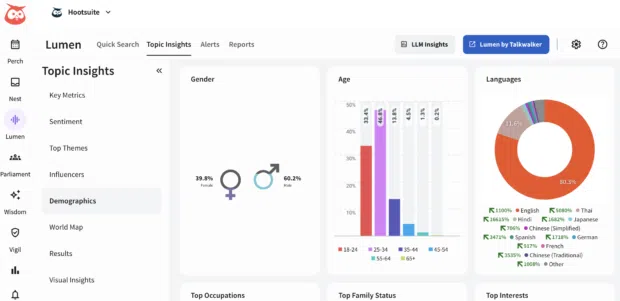
At a deeper level, measurement reveals what your audience likes, what they don’t like, and what they expect from your brand. This gives you critical insight into their behaviors, like when they’re most likely to be online.
Target market preferences and pain points
Social media measurement helps you identify your true target market and what problems your brand is best positioned to solve.
But first, a quick distinction:
- Your social media audience is everyone who follows or engages with your brand.
- Your target market is a more specific set of people. It’s those who are most likely to actually buy your product and services.
By measuring how these groups interact with your content, you can see what matters most to your ideal customers and tweak your messaging, content, and strategy to match.
Competitive insights
Social media measurement helps you identify your top competitors and understand how they’re using social media to connect with your shared audience.
This allows you to benchmark your own overall performance against relevant accounts, spot new competitive threats as they emerge, and identify gaps in your own social strategy.
For example, you can take a look at how often your competitors post, what types of content they post, and how those factors impact their engagement rates.
You can also zoom out and see what kinds of topics they cover and how much of the overall industry conversation they own. Benchmarking your social share of voice against competitors is one of the fastest ways to see whether you’re gaining or losing ground in that conversation.
Content performance
Social media measurement allows you to understand the performance of your social content at both the micro and macro levels.
On the macro level, you can see how things are trending overall. What are the big picture shifts in your engagement, follower growth, and reach?
Ultimately, this broad view helps you see whether your social strategy, in general, is on the right track. You can also measure the ROI of your social media efforts as a whole.
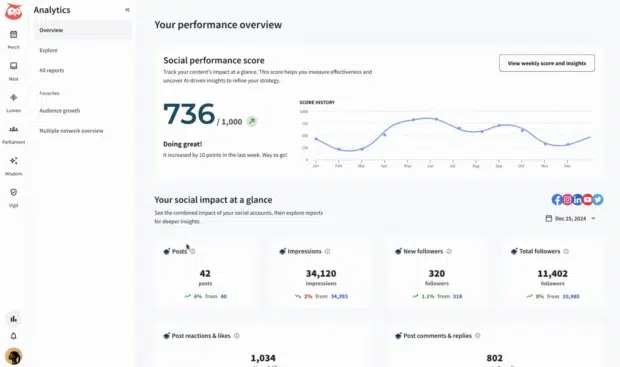
On the micro level, you can measure the performance (and ROI) of individual posts and marketing campaigns.
Here, you’re looking at more detailed insights. What specific types of content perform best (photo, video, text, etc.)? What caption length and style see the most engagement? What calls to action drive the most clicks?
AI-powered insights can speed this up by surfacing patterns across hundreds of posts, so you spend less time pulling data and more time acting on it.
Brand awareness, perception, and reputation
Social media measurement can show how visible your brand is and how people feel about it.
This includes quantitative data — like what percentage of the online conversation is about you — with qualitative data, like sentiment, to give you a complete picture of brand perception.
Tracking brand sentiment over time is what turns those signals into something useful. A steady sentiment score with rising mention volume usually means healthy growth. A drop in sentiment while volume spikes is a warning sign that something needs attention today, not at the end of the month.
Most importantly, ongoing measurement helps you spot sudden shifts in brand reputation, so you can lean into your wins and nip impending crises in the bud. Real-time monitoring shortens the gap between a conversation starting and your team responding, which is often the difference between a manageable issue and a full crisis.
How to choose the right social media metrics for your goals
Choose your metrics by starting with the outcome you’re accountable for, then working backward to the numbers that prove it. A metric earns its place on your dashboard only if it tells you something you’d act on.
That’s the practical difference between vanity metrics and actionable ones. Follower count on its own rarely changes a decision. Follower growth rate paired with demographic shifts tells you whether you’re reaching the right people. Both are metrics, but only one functions as a KPI.
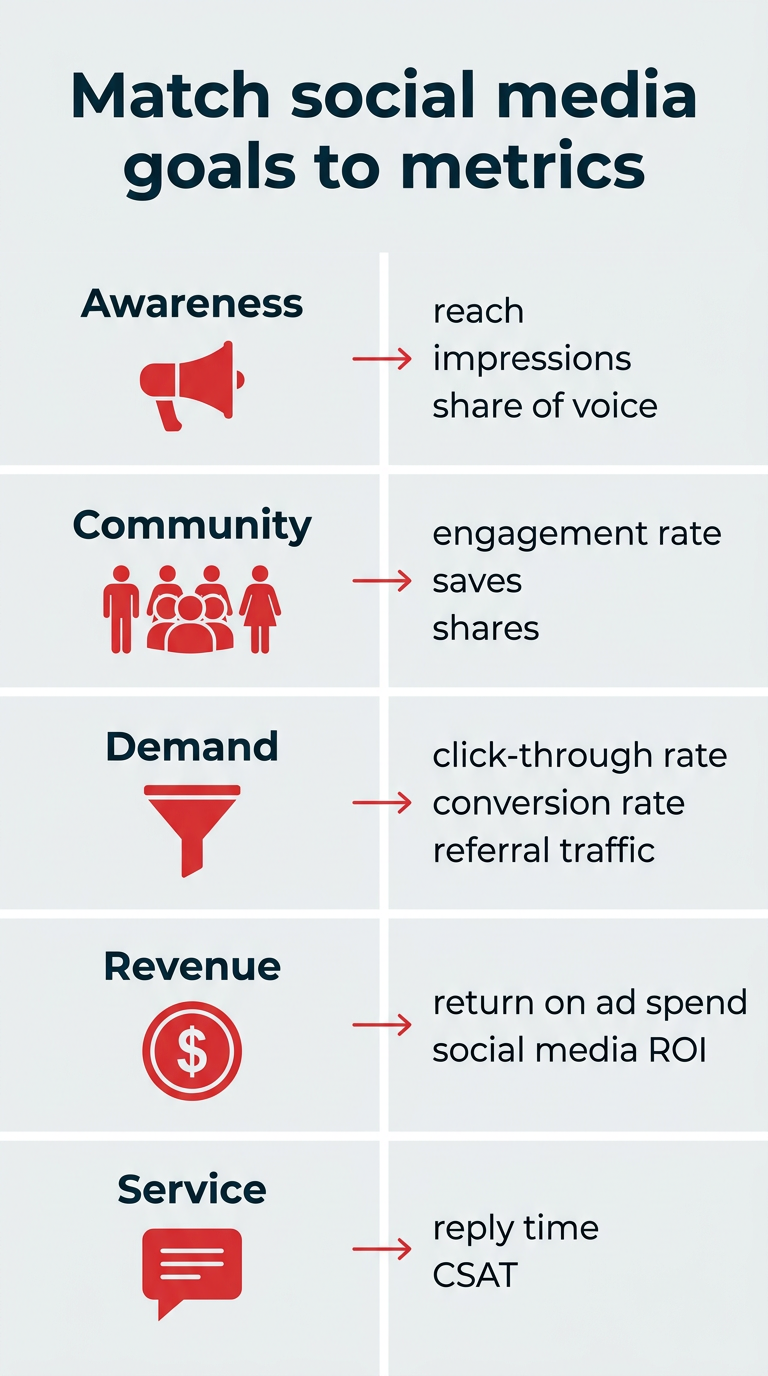
Here’s how common business goals typically map to metrics:
- Awareness goals: Focus on reach, impressions, and share of voice
- Community goals: Focus on engagement rate, saves, and shares
- Demand goals: Focus on click-through rate, conversion rate, and referral traffic
- Revenue goals: Focus on return on ad spend and social media ROI
- Service goals: Focus on reply time and customer satisfaction scores
Business goal | Key metrics | Where to track |
|---|---|---|
Brand awareness | Reach, impressions, social share of voice, follower growth | Lumen, platform analytics |
Engagement | Engagement rate, comments, shares, saves | Perch, platform analytics |
Lead generation | CTR, conversion rate, social referral traffic | Google Analytics, CRM |
Revenue and ROI | ROAS, social media ROI, CPC | Ad platforms, CRM, Hootsuite Social OS |
Customer satisfaction | CSAT, NPS, reply time | Nest, CRM |
If you’re still shaping your objectives, our guides to social media goal-setting and building key performance indicators walk through the process step by step.
What social media metrics should you measure?
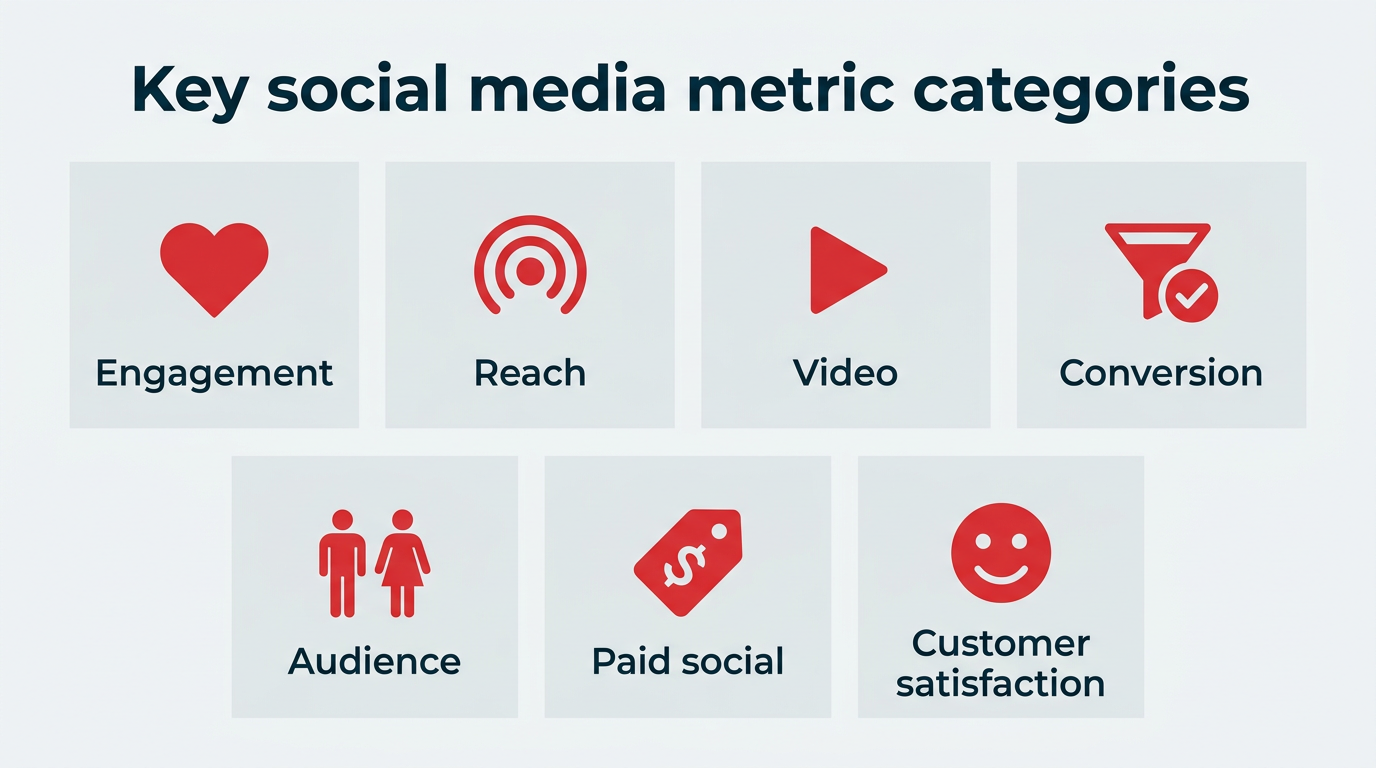
The most important social media metrics to measure are engagement, reach, conversions, and audience metrics.
That said, the right metrics are the ones that matter most to your brand. If a metric doesn’t give you visibility into your goals, or help guide strategic decisions, it’s probably a nice-to-have.
Here are the key areas to focus on when measuring the success of your social media efforts.
Engagement metrics
Engagement metrics measure how much people interact with your social content. It’s an important measure of how well your content connects with your target audience.
High engagement also gives you credibility with new visitors and sends powerful signals of content quality to the algorithms.
Engagement metrics to track include:
- Total engagements: The total number of likes, comments, shares, and saves, either for a specific post or for a certain time period
- Engagement rate: Total likes, comments, shares, and saves divided by number of followers x 100 to get a percentage
Note: Measuring engagement rates is actually a whole topic in itself, thanks to its many formulas. We’ve got a whole blog post on calculating engagement rate to help you out!
It’s also important to think of engagement quality, and not just volume. For instance, comments typically signal more interest than likes, and saves signal even stronger intent because someone plans to come back to your content.
Not sure what engagement rate to aim for? Here are the overall engagement rates from Hootsuite’s own benchmark data:
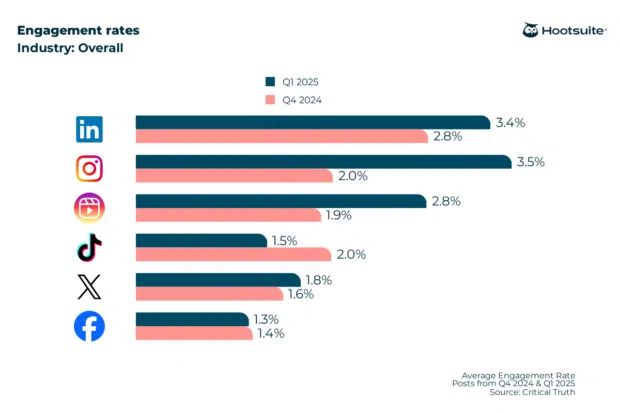
Engagement rates vary a lot by industry. The best social media measurement tools include benchmarking features that allow you to compare yourself to your peers. (More on those tools below.)
Reach metrics
Reach metrics give you a sense of how large your social audience is. They’re one of the clearest ways to understand brand awareness and whether your content is reaching beyond your existing audience.
Important social media reach metrics include:
- Reach: The number of people who see your content
- Impressions: The number of times people saw your content. This can be higher than reach if people look at your content more than once.
- Social share of voice (SSoV): How much of the social conversation in your industry is about you. Divide your brand mentions by total mentions of you plus your competitors, then multiply by 100. It’s a tricky one to calculate manually, so look for a measurement tool that does it for you. Lumen inside Hootsuite Social OS calculates SSoV automatically.
When measuring reach, look at how much of your reach comes from followers compared to non-followers.
For instance, a high percentage of non-followers indicates that your content is being shared or getting a bump from the algorithm. These are both signs of quality content, and they’re the clearest evidence that awareness goals are being met.
Video performance metrics
Video performance metrics show how your video content resonates with viewers beyond basic engagement and reach.
The most important video metrics to track are:
- Video views: The number of times your video has been watched. On Facebook and Instagram, 3 seconds counts as a view. On TikTok, a view is counted after roughly one second of playback (about three seconds for videos three minutes or longer). On LinkedIn, a campaign video view counts when there’s 2 or more continuous seconds of playback while the video is at least 50% on screen
- Video completion rate: The number of people who watch your video to the end divided by the number of impressions x 100 for a percentage
- Watch time: The total amount of time people spent watching your videos over a certain period
View thresholds change from time to time, so check each platform’s current documentation before you compare numbers across networks.
To put video performance in context, compare it with other content formats. For example, Hootsuite’s data shows that videos (Reels) have lower engagement than carousels on Instagram.
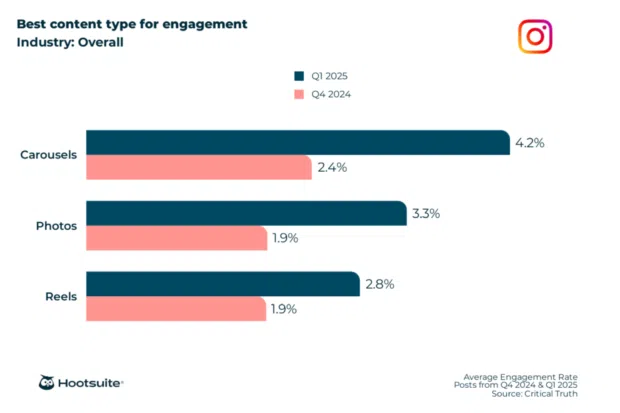
If engagement is your top priority, it could be beneficial to test non-video content types.
Conversion metrics
Conversion metrics indicate how your social content is contributing to real business outcomes, like leads, sign-ups, and sales.
Key social media metrics to track for conversion are:
- Conversion rate: The number of people that performed a desired action (purchase, sign-up, etc.) divided by the number of clicks on your social links
- Click-through rate (CTR): The total number of clicks divided by the number of impressions x 100 to get a percentage
- Social media ROI: (The value generated from social media – the costs of social media investment) divided by those costs. Multiply by 100 to get a percentage. Or go the easy route and use our free ROI calculator.
If you connect with your audience through multiple touchpoints (say, email and podcast ads in addition to social media), consider using attribution models to determine how much influence social media had in the conversion path.
Multi-touch models spread credit across every interaction a buyer had, which usually gives social a fairer share than last-click reporting does—and nearly 47% of US marketers plan to invest more in marketing mix modeling over the next year.
Audience metrics
Audience metrics help you understand who your audience is, how it’s growing, and how they feel about your brand.
The most important audience metrics to track are:
- Follower count: A tally of how many followers you have, either overall or on each individual social media account
- Audience growth rate: Net new followers divided by total number of followers x 100 to get a percentage
- Social media sentiment: This is a measure of how positive or negative the social conversation about your brand is. It’s tricky to measure, but the best social media measurement tools will calculate it for you.
- Demographics: Basic aspects of your audience, like gender, age, location, as well as when they’re most often on each social platform.
For your comparison, here are our findings on the average follower growth rate.
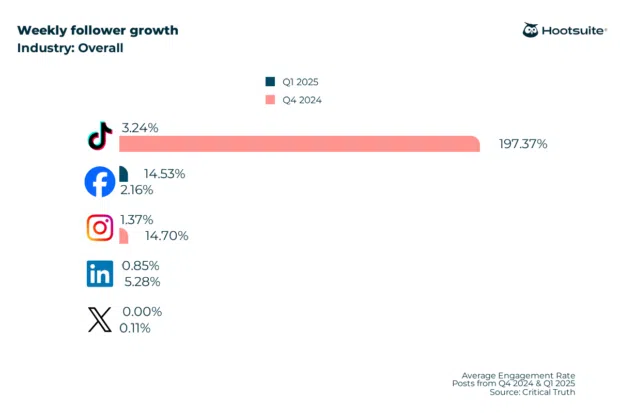
Looking at these metrics over time helps you spot meaningful changes in your audience. For example, after a major spike or drop in follower growth, dig into demographics to see whether your audience still matches the market you’re trying to reach.
If you’re getting followers you didn’t expect, it may be that your target market is evolving, and your content strategy needs to shift accordingly. Or, it could be that you need to refocus on your audience rather than going for broad appeal.
For more details on these and other social marketing metrics, check out our post on essential metrics to measure social media success.
Paid social metrics
Paid social metrics show what your ad spend is actually buying. With global social media ad spend projected to reach $338.75 billion in 2026, most enterprise teams run paid alongside organic, so leaving these out of your reporting leaves a hole in the story.
The paid social metrics to track are:
- Cost per click (CPC): Total ad spend divided by total clicks. A rising CPC on a stable campaign usually points to audience fatigue or increased competition in the auction.
- Cost per thousand impressions (CPM): Total ad spend divided by impressions, multiplied by 1,000. Useful for comparing the efficiency of awareness campaigns across platforms.
- Return on ad spend (ROAS): Revenue attributed to your ads divided by ad spend. A ROAS of 4 means you earned $4 for every $1 spent.
- Paid click-through rate: Ad clicks divided by ad impressions x 100. Track this separately from organic CTR, since the benchmarks are very different.
Reading paid and organic results side by side is what makes the numbers useful. If a topic performs well organically, it’s often worth putting spend behind it, and paid results can tell you which messages deserve a bigger organic push.
Customer satisfaction metrics
Customer satisfaction metrics measure how well your team serves people who come to social with questions, complaints, and requests. As more customers use social as a first support channel, these numbers belong in your measurement plan alongside engagement and reach.
The customer care metrics to track are:
- Customer satisfaction score (CSAT): The percentage of customers who rate their experience as satisfied or better, usually collected through a short post-conversation survey
- Net promoter score (NPS): The percentage of promoters minus the percentage of detractors, based on how likely customers are to recommend you
- Average reply time: The average time between a customer message arriving and your team responding
- Total response volume: The number of inbound messages your team handled in a given period, which helps you plan staffing and spot demand spikes
Nest, the inbox and engagement app inside Hootsuite Social OS, brings messages from every connected channel into one place and tracks reply times and volume, so care performance sits in the same reporting as everything else.
How do you set up a social media measurement process?
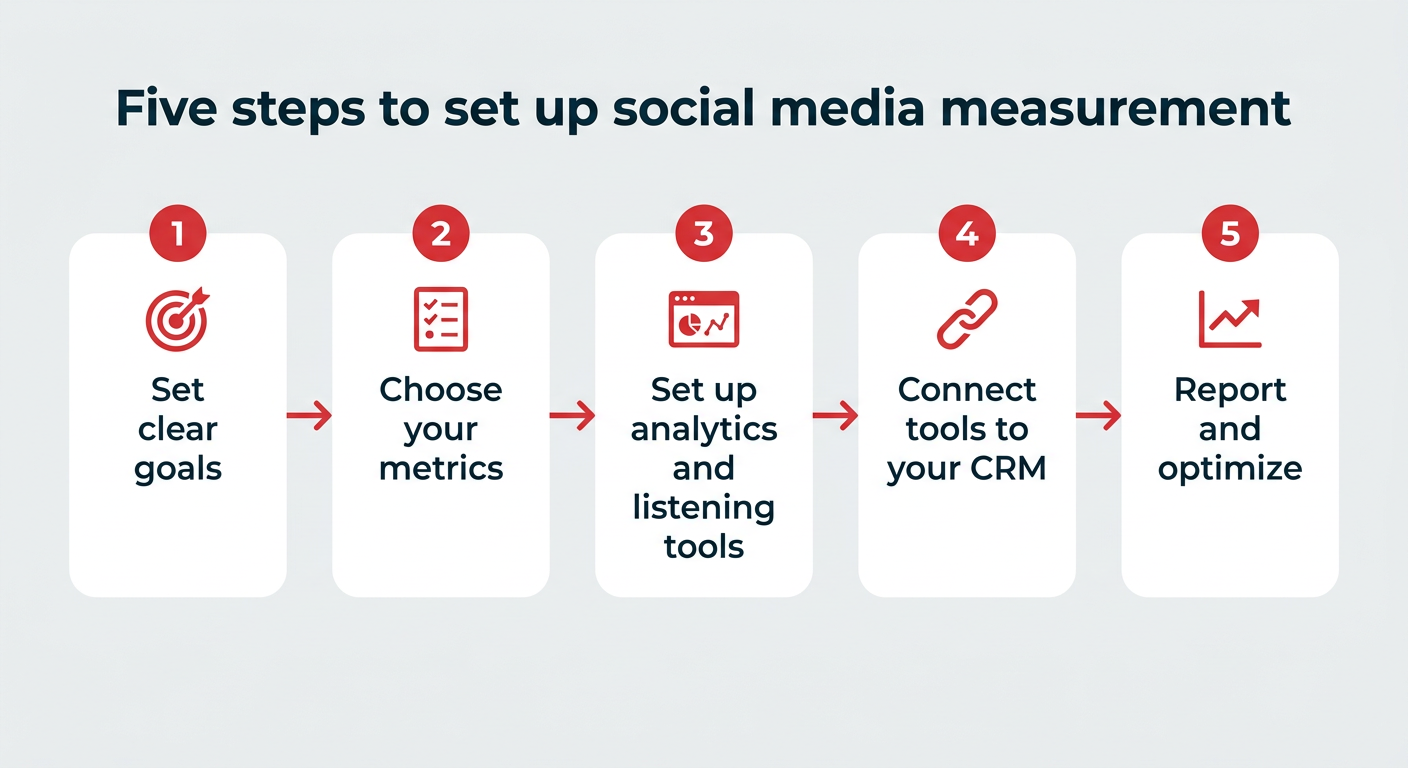
You can set up a smart social media measurement process by aligning goals, metrics, tools, and reporting into a repeatable system.
Here are the five key steps:
- Set clear social media goals
- Choose the metrics you’ll track
- Set up analytics and social listening tools
- Connect your measurement tools to your CRM
- Report, reassess, and optimize
1. Set clear social media goals
To get the most of your social marketing efforts, connect your social media metrics to real business goals.
Keep in mind that your goals and associated measurement strategies may vary by platform, or even by campaign. The important thing is to know what you want to achieve with your data, rather than just collecting it because you can.
As covered above, start by mapping each goal to a small set of specific KPIs before you open a single dashboard.
2. Choose the metrics you’ll track
The metrics you track should help you gauge your progress towards your stated goals and KPIs. The goal-to-metric table earlier in this post is a good starting shortlist.
For example, if your primary goal for TikTok is building brand awareness, focus more on reach and audience metrics there. If you’re using shoppable posts on Instagram to drive sales, you’ll want to track conversions.
3. Set up analytics and social listening tools
All major social media platforms have native analytics tools. These are a good place to get started with social media measurement, since they’re free to use and require very little set-up.
We cover all the major native analytics solutions (plus Google Analytics) in our post on social analytics tools (this link takes you directly to the section on free tools).
Native tools have a ceiling, though. Each one only sees its own platform, the metric definitions don’t always match, and nothing carries over when someone leaves the team. For teams managing several brands or regions, connected systems save hours of manual consolidation and keep everyone working from the same numbers.
Inside Hootsuite Social OS, Perch handles publishing and content analytics across your connected channels, while Lumen covers listening and insights so you can see what’s happening beyond your own accounts. Both feed the same reporting layer.
We’ve also created a free social media reporting template where you can collect all your data for analysis.
For competitive and audience insights, you’ll also want to set up social listening. We’ve got a post dedicated to the best social listening tools to help you choose the one that works best for you.
If you’re not sure what to track, or how to find the social media data you need, check out the reporting templates in your social analytics tool of choice. Choose one that aligns with your goal, as it will be pre-populated with the most relevant metrics.

4. Connect your social measurement tools to your CRM
Connecting your social media measurement tools to your CRM helps you understand how social supports your sales funnel and greater business objectives.
When your social data lives alongside customer and lead data, every team gets a clearer, more complete view of performance.
You gain richer audience insights, stronger attribution, and a better understanding of how social contributes to pipeline and revenue.
In practice, that looks like passing social conversations and lead form submissions into Salesforce so a rep can see the full history before they reach out. It also means you can trace which campaigns and channels appear most often in closed-won deals, rather than assuming.
Hootsuite’s Salesforce integration is available on Enterprise plans and syncs social interactions with customer records, so support and sales teams share the same context.
This is also the step that makes ROI conversations with leadership easier. Once social data sits in the same system as revenue data, you’re presenting contribution to pipeline rather than defending engagement numbers.
5. Report, reassess, and optimize
Many stakeholders across your organization are interested in your social media measurement findings, so treat every report as a decision point rather than a status update.
When you review your data, assess whether your social marketing strategy is working. Are your goals still realistic? Is there something new on the horizon you need to start tracking? Every report is an opportunity to reassess and optimize.
Where results are flat, change one variable at a time so you can tell what actually caused the shift. Where results are strong, document what you did so the win is repeatable.
Pro tip: Make sure reports connect your social team’s contributions to real business value. A focus on social performance reinforces the importance of your work and your social media measurement plan.
What are the best social media reporting tips?
The best reporting habit is to give each audience only the numbers they can act on, in a format they’ll actually read. Reporting is where measurement either earns budget or gets ignored.
A few practices make the biggest difference:
- Agree on definitions first: Write down how your organization calculates engagement rate, reach, and conversions, then use those definitions everywhere. Nothing erodes trust faster than two teams reporting different numbers for the same campaign.
- Set your reporting cadence: Most social teams review data weekly for tactical adjustments, with a deeper monthly dive to look for longer-term trends. For senior stakeholders, a high-level monthly report is usually enough.
- Tailor the report to the reader: Practitioners need post-level detail. Executives need contribution to business goals and a clear recommendation. Don’t overwhelm team members and stakeholders with data points that aren’t relevant to their role or decision-making.
- Tell a story, not a data dump: Lead with what changed, explain why, and end with what you’ll do next. Charts support the argument; they aren’t the argument.
- Revisit what you measure: When strategy shifts, retire metrics that no longer map to a goal. A dashboard that only grows becomes noise.
What are the best social media measurement tools in 2026?
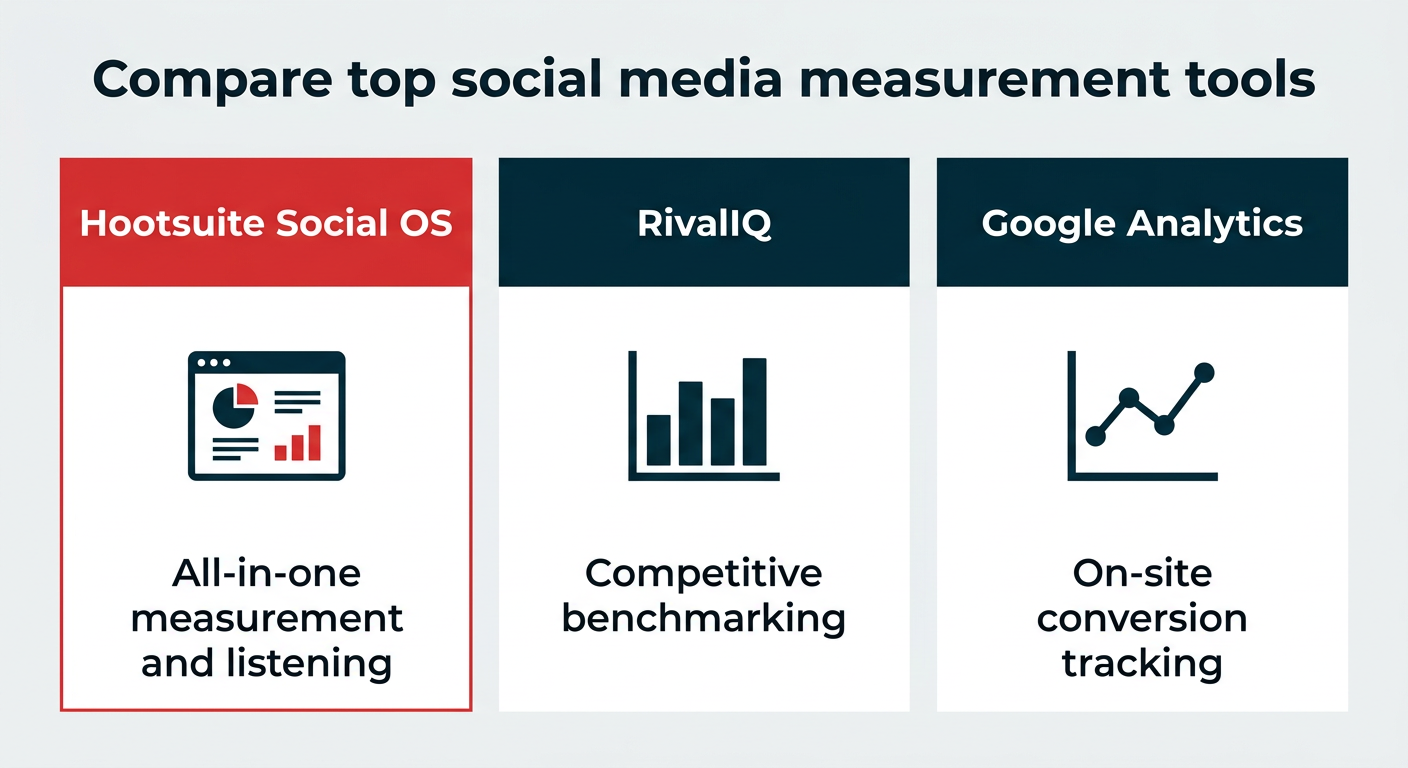
The best social media measurement tools depend on your goals, team size, and how much of your reporting needs to live in one place. Here are three worth considering.
1. Hootsuite Social OS
Hootsuite Social OS is a social operating system that brings measurement, listening, publishing, and engagement into connected systems instead of separate tabs.
Three apps do most of the measurement work:
- Perch covers publishing and content analytics, so you can see how every post and campaign performed across your connected channels.
- Lumen handles listening and insights, tracking brand mentions, sentiment, and share of voice beyond your own accounts.
- Wisdom lets you ask questions in plain language and returns answers with the underlying data cited, which shortens the path from question to decision.

You can benchmark against competitors, build custom reports for different stakeholder groups, and connect social data to your CRM so social sits in the same reporting as the rest of the business.
Key feature: Get personalized recommendations for the best time to publish on each of your social platforms without having to calculate this manually.
Best for: Teams that want listening data and performance metrics in one measurement program rather than stitched together after the fact.
Price: According to Hootsuite’s pricing page, Standard is $99/user/month, Advanced is $249/user/month, and Enterprise pricing is custom. Advanced adds customizable analytics and report exports; Enterprise adds Lumen by Talkwalker listening, advanced analytics, and SSO.
2. RivalIQ

Source: RivalIQ
RivalIQ is an analysis tool designed to help you make data-driven decisions quickly. It can measure and compare searches of brand mentions, hashtags, and topics to give you an understanding of what’s most popular in your sphere.
Key feature: Boosted post detection based on machine learning helps you understand why a competitor is seeing greater engagement rates.
Best for: Agencies, nonprofits, and large brands.
Price: Plans start at $239/month (Drive), with Engage at $349/month and Engage Pro at $559/month; enterprise and volume packages available on request. Annual billing offers roughly a 15% discount.
3. Google Analytics
Google Analytics is where you see what happens after someone leaves social and lands on your site. It’s the missing half of most social measurement setups.
GA4 reports social referral traffic by source, tracks conversions from those sessions, and breaks out campaign performance when you tag links with UTM parameters. That makes it useful for proving that social traffic converts, not just that it arrives.
Key feature: Conversion tracking tied to UTM-tagged social campaigns, so you can attribute on-site actions back to specific posts and channels.
Best for: Teams that need to connect social clicks to on-site behavior and revenue.
Price: Free, with a paid enterprise tier
Treat it as a complement to a dedicated social measurement tool. Google Analytics can’t tell you what people are saying about your brand or how your engagement compares to competitors.
FAQ: Social media measurement
What is social media measurement, and which metrics matter most?
How do enterprises measure social media ROI?
What are best practices for social media measurement and reporting?
What KPIs should brands track for social media performance?
How do social media analytics tools support better measurement?
What is the difference between social media metrics and social media KPIs?
How often should you measure social media performance?
What are paid social media metrics?
What is the 70/20/10 rule for social media?
What are common social media metrics?
Save time managing your social media marketing strategy with Hootsuite. Publish and schedule posts, find relevant conversions, measure results, and more â all from one dashboard. Try it free today.
The post Social media measurement in 2026: Metrics & tools appeared first on Social Media Marketing & Management Dashboard.
br https://ift.tt/PBgcfq8
https://ift.tt/em9xvgr
Comments
Post a Comment