Key takeaways
- Social media OKRs connect ambitious objectives to measurable key results, turning social activity into trackable business impact.
- OKRs differ from KPIs: objectives set direction, key results measure progress, and KPIs track ongoing performance.
- Effective OKRs are time-bound stretch goals with a 60-70% target achievement rate, reviewed and refined quarterly.
- Executives should tie social media OKRs to business outcomes like revenue, brand reputation, and share of voice, not vanity metrics.
What are social media OKRs?
Social media OKRs are a way to plan and measure social media so it optimizes business performance. Think of OKRs as the bridge between ambition and accountability.
You set an objective, like improving brand awareness. Then you back it up with measurable key results, like boosting social share of voice by 10% in Q4.
As an OKR framework, goals should be ambitious to the point of a 60-70% win rate. They’re called stretch goals, meaning they’re top shelf for a reason.
Executive-level OKRs vs. team-level metrics
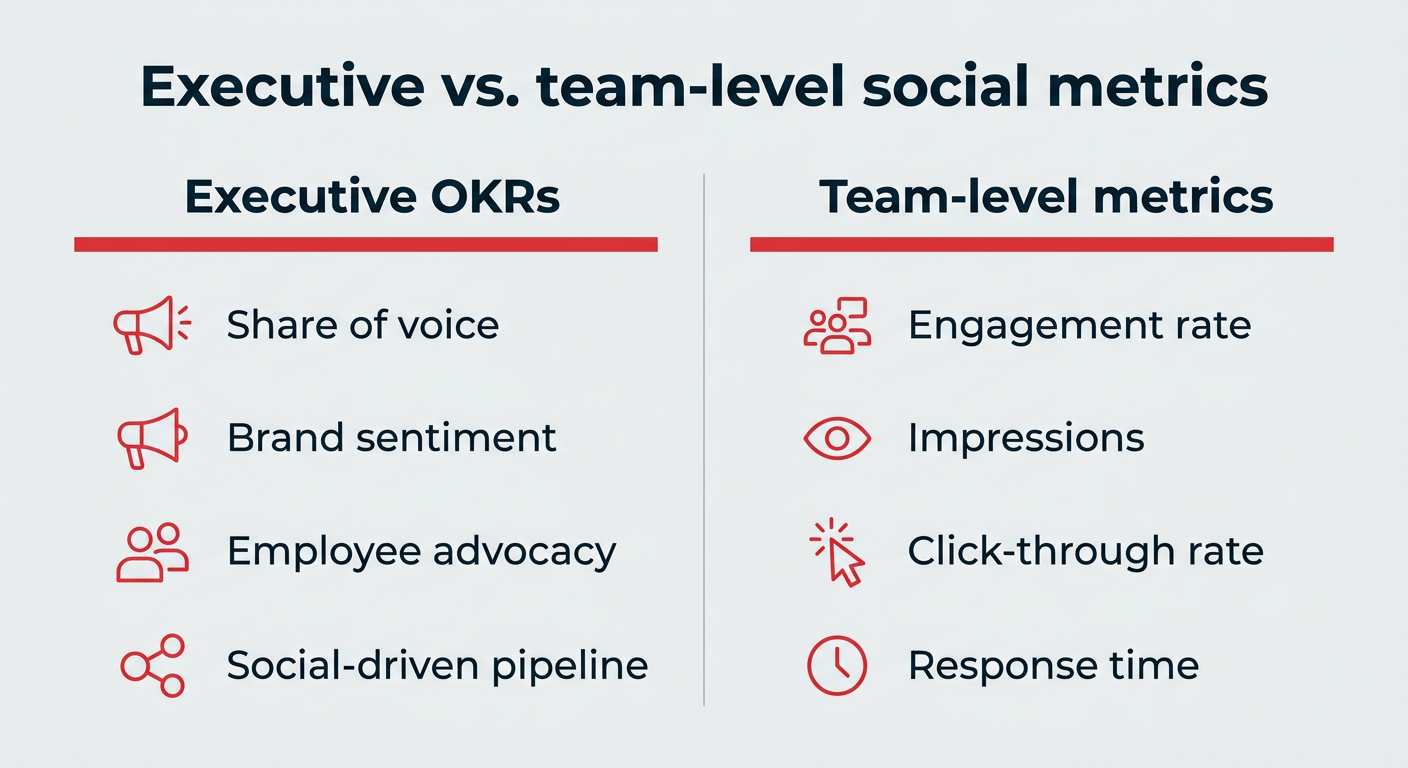
Executives use OKRs for strategic impact, while team-level metrics often involve tactical performance.
Leaders want to tie social outcomes to business goals. These could be growth, brand equity, or reputation management.
And when executives are active on social, those OKRs may shift. “When leaders are active on social, teams typically build OKRs around things like growing their visibility, strengthening thought-leadership, or increasing engagement on exec-led content,” says Paige Schmidt, Hootsuite’s Social Engagement Coordinator.
“This can (sometimes) trickle into the brand page, which can see an increase in followers and engagement there.”
Quarterly, monthly, or annually, leaders might measure:
- Share of voice
- Brand sentiment
- Employee advocacy participation and ROI
- Social-driven pipeline
Teams need to know what’s working and what’s not for their social media audience. Daily, weekly, or monthly, they might measure:
- Engagement rates
- Impressions
- Click-through rates
- Response times
Why OKRs are critical for social media leadership
OKRs are how social media leaders connect effort to impact. They turn “we’re busy on social” into “here’s what that busyness achieved.”
As a goal-setting framework, OKRs link objectives to measurable results. You can show how social drives revenue with website traffic and referrals. Or customer satisfaction through community sentiment.
OKRs also keep strategy honest. When you track what matters, you can tell what’s working, what’s not, and where to double down.
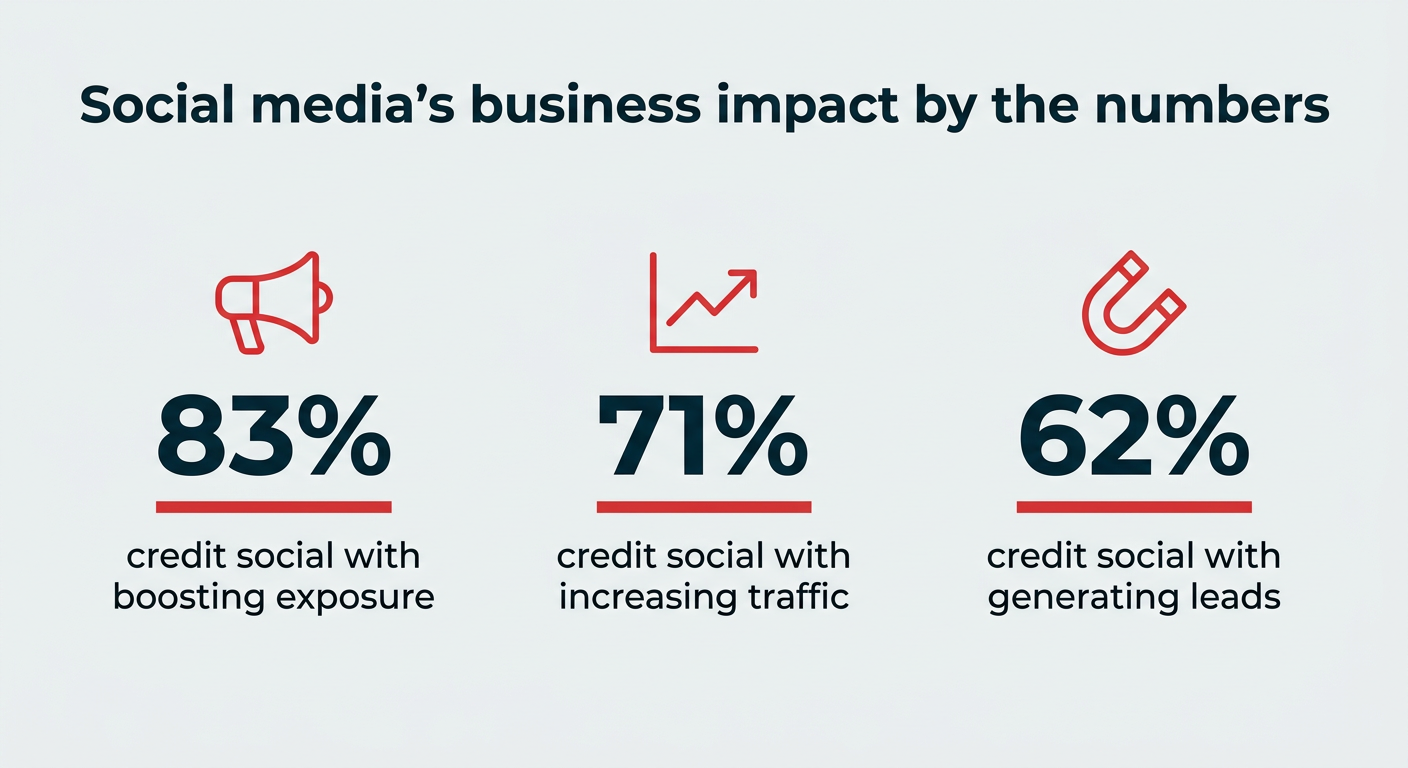
The value is clear in the data. According to Statista, 83% of marketers credit social with boosting exposure, 71% with increasing traffic, and 62% with generating leads. OKRs give leaders a framework to capture and measure that value.
Other benefits of OKRs for social media leadership:
- Keeps social strategy aligned with C-suite priorities like revenue, risk, and reputation.
- Distinguishes between “busy work” and meaningful impact.
- Enables distributed team members to execute toward shared goals. Gartner research found aligned goals can improve employee performance by 22%.
- Makes it easy to track and prove social ROI in quarterly reviews.
- Encourages continuous improvement and adaptability as social roles evolve with AI, regulation, and brand governance.
When Google adopted OKRs in 1999, CEO Larry Page said they helped lead Google to 10x growth, many times over, as recounted in John Doerr’s Measure What Matters.
Google used OKRs to focus on bold but measurable outcomes. Take Google Chrome, for example.
During the rollout, as described in Doerr’s Measure What Matters, the objective was to develop the next-generation client platform for web applications. Ambitious? Definitely. The key result was to reach 20 million weekly active users. And they did it.
What’s the difference between OKRs and KPIs?
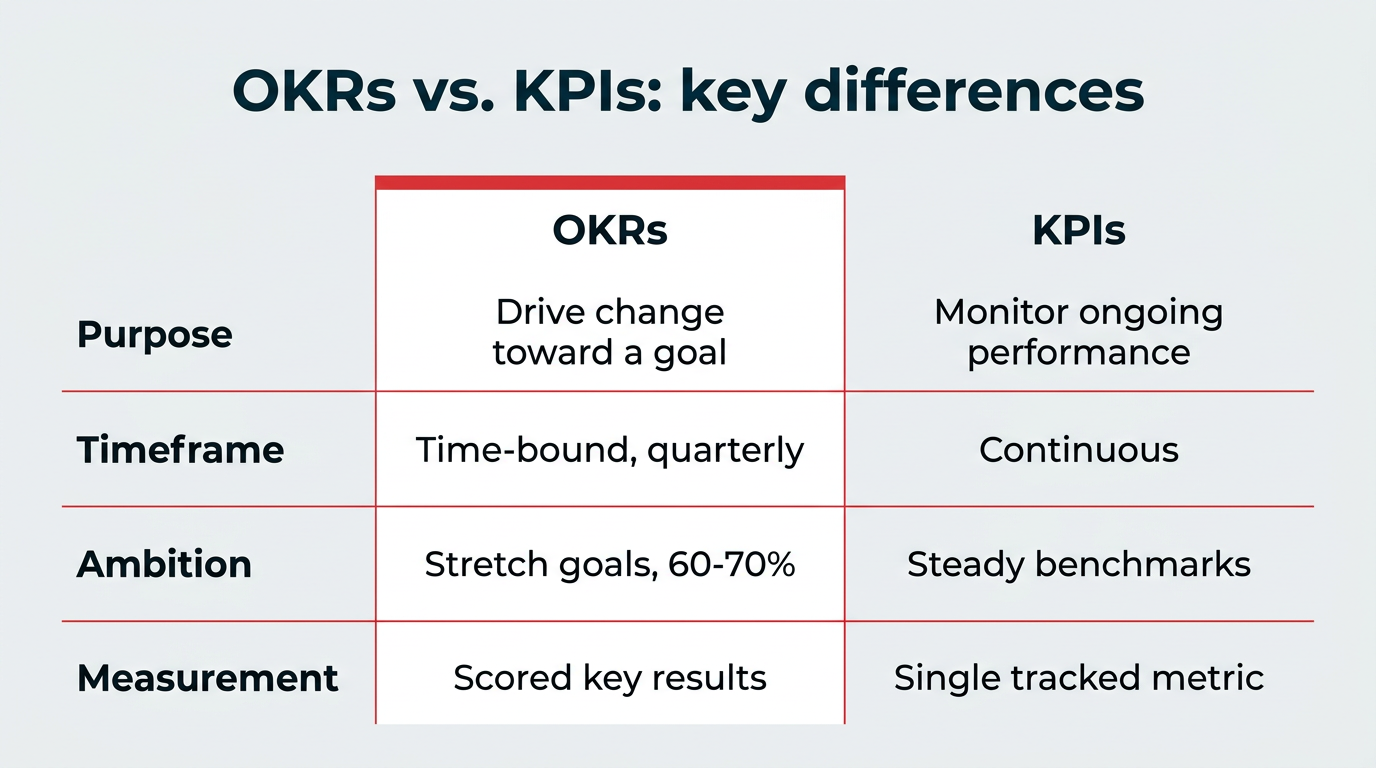
The difference between OKRs and KPIs comes down to purpose. OKRs are ambitious, time-bound goals with measurable key results that push your team toward change. KPIs are ongoing performance metrics that track the day-to-day health of your social channels.
Both matter, and they work best together. A KPI can feed directly into an OKR. For example, engagement rate is a KPI you monitor continuously. An OKR built on it might be: “Grow engagement rate by 15% in Q3.”
Dimension | OKRs | KPIs |
|---|---|---|
Purpose | Drive change toward a goal | Monitor ongoing performance |
Timeframe | Time-bound (usually quarterly) | Continuous |
Ambition level | Stretch goals (60-70% target) | Steady-state benchmarks |
Measurement | Objective plus scored key results | Single tracked metric |
Social media example | “Increase share of voice by 10% vs. top three competitors by Q3” | “Maintain a 4% engagement rate” |
In short, KPIs tell you where you stand today, and OKRs tell you where you want to go next.
Why do executives need social media OKRs in 2026?
In 2026, social media can’t live in a marketing silo. It’s where brand, business, and nearly 5.75 billion users all meet. Executives need clear OKRs to connect social activity to real business outcomes.
Without them, visibility becomes vanity. Don’t spend time, budget, and creative energy showing up online without ever knowing why it matters.
OKRs are more relevant now, not less. Evolving social trends, from AI-driven tools to multi-channel fragmentation and rising governance complexity, all make structured goal-setting essential. When there’s more to manage, a shared framework keeps everyone aligned on what success looks like.
Align social media goals with business strategy
Executive OKRs ensure your social strategy works as a business driver. When social goals ladder up to organizational priorities, every post, partnership, and campaign contributes directly to growth, reputation, or revenue. Without that link, a social team can spend a quarter optimizing for follower count while the business actually needs pipeline.
Drive growth and innovation through measurable objectives
Clear OKRs give social teams permission to experiment while staying accountable. OKRs force creative ideas to be measurable and help executives know which innovations move the business forward.
Prove ROI and protect your social media investment
With OKRs, leaders can demonstrate social’s impact on the bottom line.
Newsweek is a strong example. CEO Dev Pragad launched an OKR-based overhaul of the publisher’s digital strategy. His objective was to increase revenue using digital ads, with a key result of growing total ad revenue for Q4 2020 versus Q4 2019 by 50%. Pragad achieved rapid audience growth (100 million+ unique visitors a month) and netted a 166% increase in digital ad revenue.
Build executive credibility in a digital-first world
Social presence is executive presence. When you’re intentional in your OKR-backed social strategy, you show your audience that your leadership team is an authority in the industry. Edelman’s 2025 B2B research found 95% of decision-makers say thought leadership makes them more open to sales outreach.
What should executive social media OKRs include?
Executive social media OKRs should include ambitious, qualitative goals that align with your overall business strategy (the objectives), plus specific, measurable outcomes that prove the objective is met (the key results).
OKRs can cover revenue, brand authority, lead generation, and customer loyalty, to name a few. Let your OKRs be defined by your strategic business goals.
Strategic outcomes vs. tactical outputs
Strategic outcomes focus on long-term business impact, like brand trust. Tactical outputs are the steps that get you there, like a campaign focused on thought leadership behind industry trends.
Make sure you’re focusing on strategy instead of tactics by:
- Starting with your company’s top priorities
- Translating those priorities into social objectives
- Setting measurable key results to support your objective
- Reviewing alignment quarterly to make sure you’re on track
For example, say your company is experiencing high employee attrition, so the business goal is retention. Your social objective is to increase team morale through social media advocacy programs. Your key results could be to increase employee retention rates by 25% by Q2, and achieve 80% or higher employee satisfaction rates annually.
Metrics for engagement, reach, and conversion
At the executive level, vanity metrics won’t cut it. OKRs should be aspirational and linked to business goals.
So, when it comes to engagement, reach, and conversion, your OKRs could look like this:
- Engagement objective:
To increase positive engagement that results in a 15% increase in revenue attributed to social
- Engagement key results:
Attribute $25K in pipeline influenced by social leads by Q2
Increase social-assisted conversions by 25% by EOY
Launch two co-marketing campaigns driven by social insights by EOY
- Reach objective:
To expand brand visibility among key audiences and strengthen share of voice across target markets
- Reach key results:
Increase share of voice by 10% versus our top three competitors by Q3
Grow executive and brand social followings by 30% across priority channels
Secure five earned media mentions or reposts from verified industry accounts
- Conversion objective:
To turn social engagement into measurable business outcomes that directly impact sales and member growth
- Conversion key results:
Achieve a 20% lift in traffic from social to conversion-optimized pages
Improve social-to-lead conversion rate from 3% to 5% by EOY
Generate 500 qualified leads through paid and organic social campaigns
Governance, risk, and cross-functional alignment
Social doesn’t live in a vacuum, and neither should your OKRs. Strong executive OKRs include:
- Safeguards for brand reputation
- Compliance
- Alignment across teams like HR, PR, and customer service
You can achieve alignment by:
- Bringing every stakeholder to the table early and often. This way, social goals reflect shared priorities.
- Creating OKRs that span departments. For example, a single objective could touch both marketing and HR, like using social media to strengthen employer brand and talent retention.
- Defining shared key results. HR might target 20% more job applications from social, while marketing aims to increase positive sentiment on career posts by 15%.
- Keeping communication consistent. Regular OKR check-ins ensure updates flow both ways and everyone stays on brand, on message, and on track.
Social media OKR examples for 2026
These OKR examples for social media give you a starting point you can adapt for your own organization. They’re grouped by business objective, from brand reputation and revenue to advocacy, governance, and innovation, so you can pick the ones that map to your priorities.
Objective | Key results |
|---|---|
1. Strengthen brand reputation using LinkedIn | -Increase positive brand sentiment by 15% quarter-over-quarter using thought leadership articles on industry trends. -Grow CEO LinkedIn followers by 30%. -Secure 3 earned media mentions from executive posts on LinkedIn. |
2. Drive measurable business impact from engagement on social media platforms | -Attribute $500K in pipeline influenced by social leads by EOY. -Increase social-assisted conversions by 25% by Q2. -Launch two co-marketing campaigns driven by social insights by EOY. |
3. Build a culture of social advocacy across the organization | -Have 60% of employees activate Hootsuite Parliament by Q2. -Achieve 10% engagement rates on internal advocacy posts for Q1. -Bring employee satisfaction rates (re: culture) up to 80% on Q2’s internal survey. |
4. Elevate brand trust and crisis preparedness | -Reduce average social response time during incidents to under 30 minutes. -Conduct two brand reputation simulations per year. -Achieve 90% compliance training completion for social teams by EOY. |
5. Strengthen the reputation of our executives as thought leaders | -Publish one high-performing thought leadership social media post per week, authored by executive team. -Earn five+ inbound speaking or PR opportunities by EOY. -Achieve 10% increase in leadership share of voice vs. competitors by end of Q2. |
6. Improve data-driven decision making on social | -Implement unified social data dashboard across regions by end of Q2. -Report on social ROI in quarterly business reviews. -Increase adoption of data-led campaign planning by 40% by end of Q2. |
7. Strengthen employer brand on social to improve talent acquisition and retention rates | -Increase applications sourced via social by 20% by EOY. -Achieve 90% employee-shares on career-related posts by EOY. -Launch 3 employee storytelling campaigns per year. |
8. Expand global social governance and compliance | -Establish governance framework across all regions by end of Q2. -Audit 100% of brand accounts for access and compliance by end of Q1. -Achieve zero unapproved account incidents per quarter by EOY. |
9. Accelerate innovation and experimentation on social | -Pilot two AI-driven social initiatives (e.g., content gen, insights) by EOY. -Launch three trend-based experiments per quarter. -Apply for three awards during social awards season. |
10. Increase net promoter score (NPS) by engaging with and supporting customers on social media | -Reduce average response time on social support channels by 25%. -Increase positive sentiment on social by 15% through proactive community engagement and issue resolution. -Resolve 90% of social-submitted customer issues within 24 hours. |
11. Increase cross-departmental collaboration on social insights | -Deliver monthly insight reports to sales, HR, and product teams. -Implement a feedback loop methodology with three cross-functional teams by Q3. -Prior to new product launches, meet with the product development team to create a social media playbook. -Drive 20% increase in cross-functional campaign adoption by EOY. |
How do you set social media OKRs?
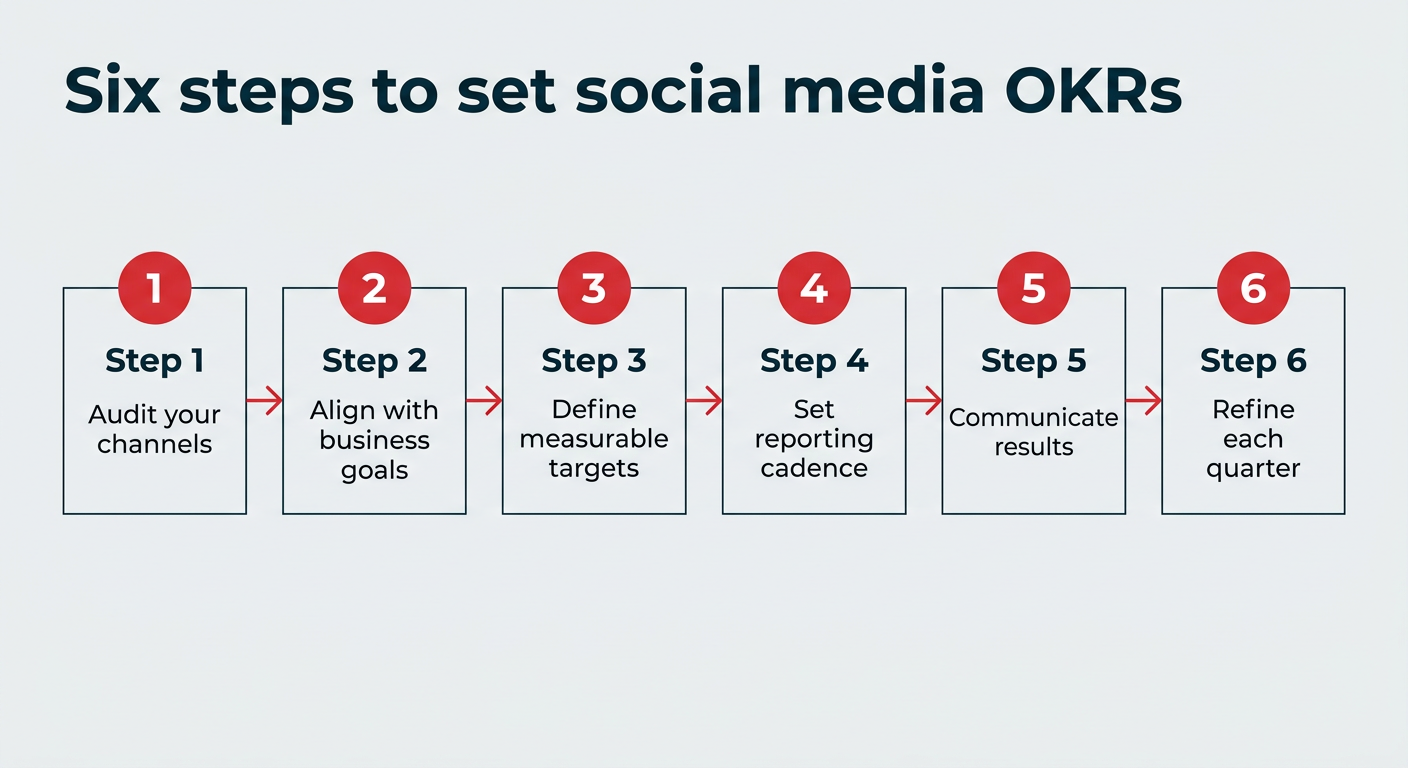
You set social media OKRs by understanding where the business wants to grow, turning those opportunities into objectives, and using social as the tool to reach them. Here are six steps to set social media OKRs:
- Conduct an enterprise social media audit
- Align OKRs with business objectives and KPIs
- Define measurable outcomes and targets
- Establish reporting cadence and accountability
- Communicate results across teams
- Refine and reset each quarter
Step 1: Conduct an enterprise social media audit
Start by taking inventory of every social channel, account, and campaign. Identify what’s performing, what’s lagging, and where your team’s time is best spent. Focus on three things: your account inventory (who owns what), performance benchmarks (current engagement, reach, and conversion rates), and content gaps (topics or formats you’re missing). This baseline tells you where realistic stretch goals should sit.
Step 2: Align OKRs with business objectives and KPIs
Your OKRs should ladder up to the company’s top priorities. Tie each objective to an existing social media key performance indicator (KPI) so social’s impact shows up in the same dashboards the rest of the C-suite cares about. The laddering looks like this: company goal (grow revenue) becomes a social objective (drive pipeline from social) which becomes key results (attribute $500K in influenced pipeline by EOY).
Step 3: Define measurable outcomes and targets
Set goals that are specific, time-bound, and quantifiable. Vague key results are impossible to score at quarter’s end. Instead of “increase engagement,” aim for “grow engagement rate by 15% in Q3.” The stronger version tells you exactly what to measure, by how much, and by when.
Step 4: Establish reporting cadence and accountability
Decide how often you’ll check progress and who’s responsible for tracking results. A common rhythm is weekly check-ins, monthly reviews, and a quarterly scoring session. Regular reviews:
- Keep momentum high
- Make it easier to adapt strategies
- Ensure no OKR gets lost in a spreadsheet
Step 5: Communicate results across teams
Share your progress beyond the social media team. Visibility builds buy-in, especially when departments like sales, HR, or PR can see how social supports their goals. A short monthly summary or a shared dashboard works better than a dense report no one opens.
Step 6: Refine and reset each quarter
OKRs aren’t set-and-forget. Use what you’ve learned to refine next quarter’s targets. The best executive OKRs evolve with the business.
How do you track and measure social media OKRs?
Once your OKRs are set, it’s all about keeping them visible, measurable, and adaptable. If you have to track and report performance across complex, multi-region organizations, you’re going to need the right tools and dashboards.
Using dashboards and reporting tools for visibility
Centralize your social data in a dashboard that shows performance at a glance. Tools like Hootsuite analytics and social listening through Hootsuite’s advocacy tools make it easy to track share of voice, engagement quality, and conversion trends.
“Key results are usually tied to social listening and performance metrics,” says Schmidt.
“For example: increases in mentions, positive sentiment, engagement on their posts, or conversation volume around the topics they’re speaking about. Those are often the clearest indicators of whether an exec’s social presence is actually having an impact.”
Hootsuite’s dashboard shows sentiment analysis and engagement metrics for tracking OKR progress.
A useful OKR tracking dashboard should include:
- Centralized data. Pull every region and channel into one view so progress is visible at a glance.
- Metrics matched to goals. Track what actually proves impact, like sentiment or share of voice for reputation, or conversions for growth.
- Automated reporting. Customize and tailor reports, then automate them so they pull updates when you need them.
- Regional reporting considerations. If something affects your SE Asia branch that wouldn’t affect your North West branch, include it in your report.
How to grade and score social media OKRs
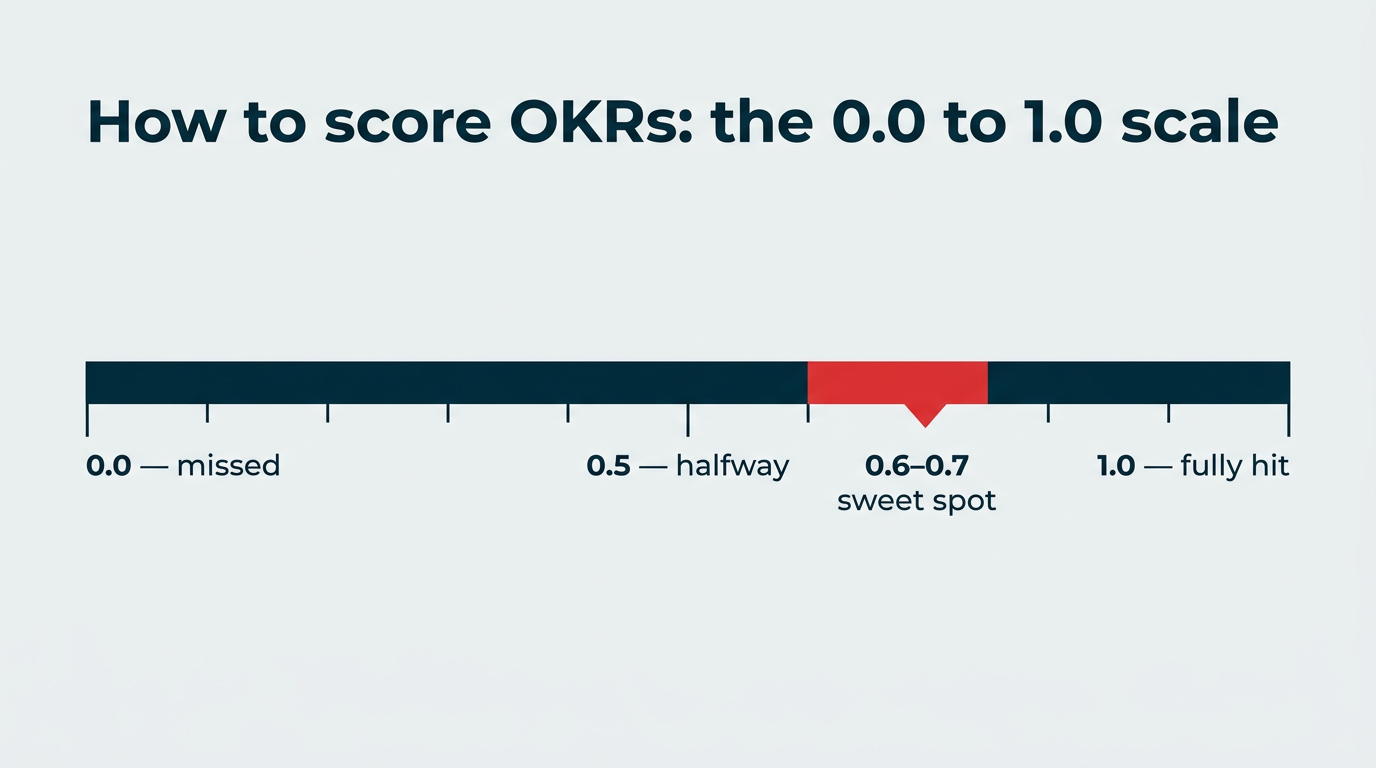
You grade social media OKRs using a 0.0 to 1.0 scale, the model Google made famous. At quarter’s end, you score each key result based on how much of it you achieved. A key result you fully hit scores 1.0, one you half-completed scores 0.5, and one you didn’t move at all scores 0.0.
The sweet spot for a stretch goal is 0.6 to 0.7. Consistently scoring 1.0 means your OKRs were too easy, and scoring near 0.0 means they were unrealistic. For example, if your key result was to grow share of voice by 10% and you achieved 7%, you’d score that around 0.7, which signals a well-calibrated stretch goal.
Connecting OKRs to team performance and business impact
Translate metrics into meaning. Show how social campaigns influence revenue, member growth, or brand reputation. Tools like a social ROI calculator can help quantify that impact. When team results connect directly to business outcomes, executives can:
- Justify investments
- Recognize top performers
- Strengthen cross-department alignment
What are the most common social media OKR mistakes?
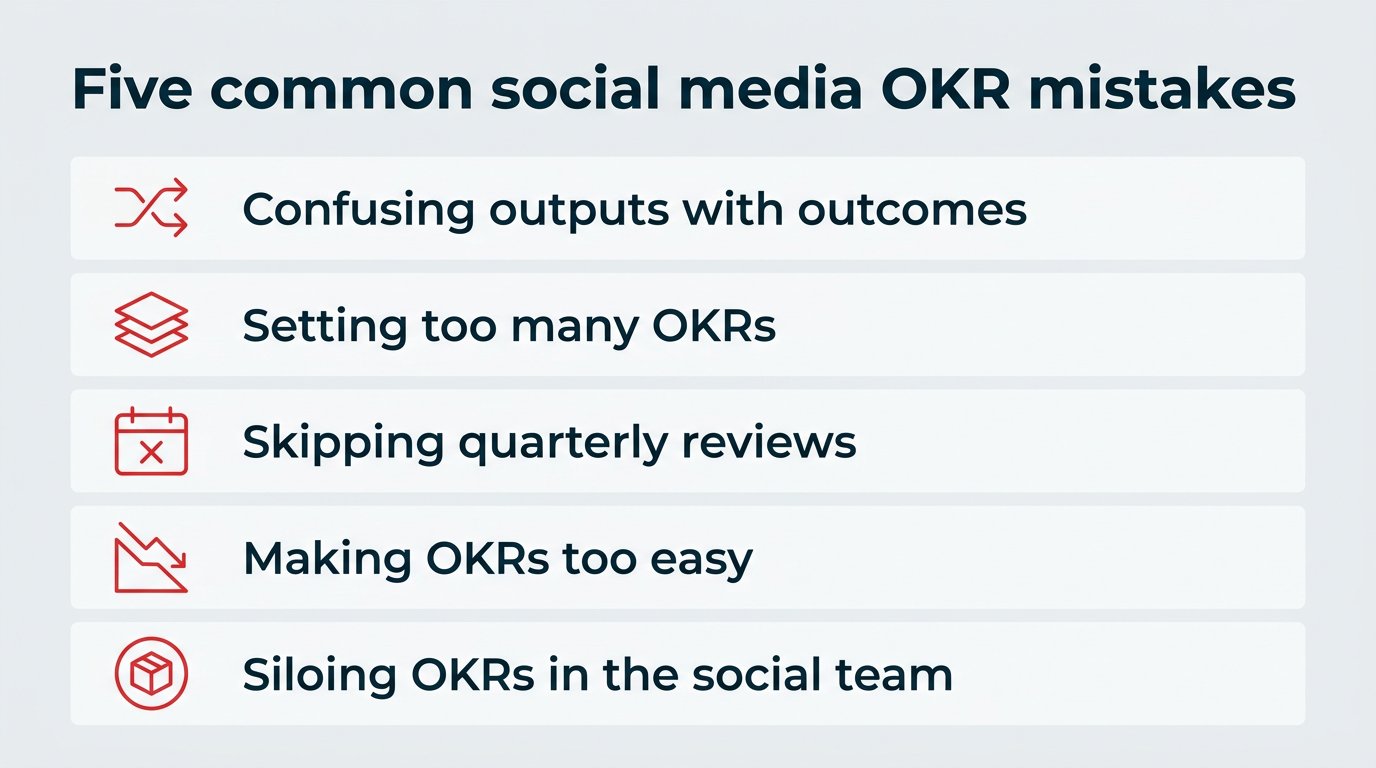
The most common social media OKR mistakes come down to measuring the wrong things or setting goals you can’t actually manage. Avoid these traps:
- Confusing outputs with outcomes: “Publish 30 posts” is an output. “Increase social-influenced pipeline by 20%” is an outcome. OKRs should measure impact, not activity.
- Setting too many OKRs: Three to five per quarter keeps a team focused. More than that spreads effort too thin and everything slips.
- Not reviewing quarterly: OKRs left in a spreadsheet die there. A quarterly review is where you score, learn, and reset.
- Making OKRs too easy: If you hit 100% every time, they weren’t stretch goals. Aim for that 60-70% achievement rate.
- Siloing OKRs in the social team: Social touches HR, PR, sales, and customer service. Shared objectives across teams drive far more impact than social-only goals.
How Hootsuite Social OS supports social media OKRs
Hootsuite Social OS supports social media OKRs with connected systems designed for social execution at enterprise scale. From unified dashboards to global alignment, it removes friction across the workflow.
Real-time insights and listening with Lumen
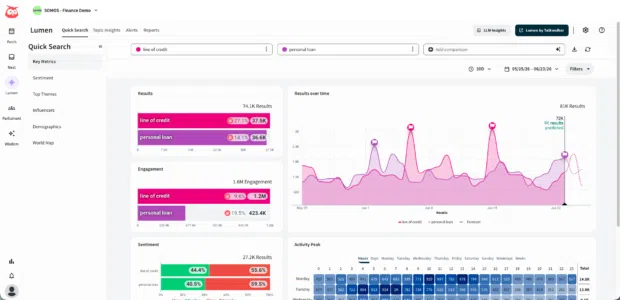
Lumen is the integrated insights and listening app inside Hootsuite Social OS, and it powers the tracking side of your OKRs. It surfaces sentiment, share of voice, competitive intelligence, and crisis signals in real time. That maps directly to OKRs like “Increase positive brand sentiment by 15%” or “Increase share of voice by 10% vs. top three competitors,” giving executives AI-powered insights without diving into spreadsheets.
Track brand awareness metrics across multiple social accounts in Hootsuite Social OS.
OKR alignment across teams and regions
Are you managing multiple brands, business units, or markets? Hootsuite Social OS keeps everything organized and aligned. Shared dashboards and permissions help teams align on objectives, while governed workflows ensure consistency, compliance, and collaboration across every region.
You can also set approval workflows within the platform, so your team can execute their tasks cleanly and stay compliant.
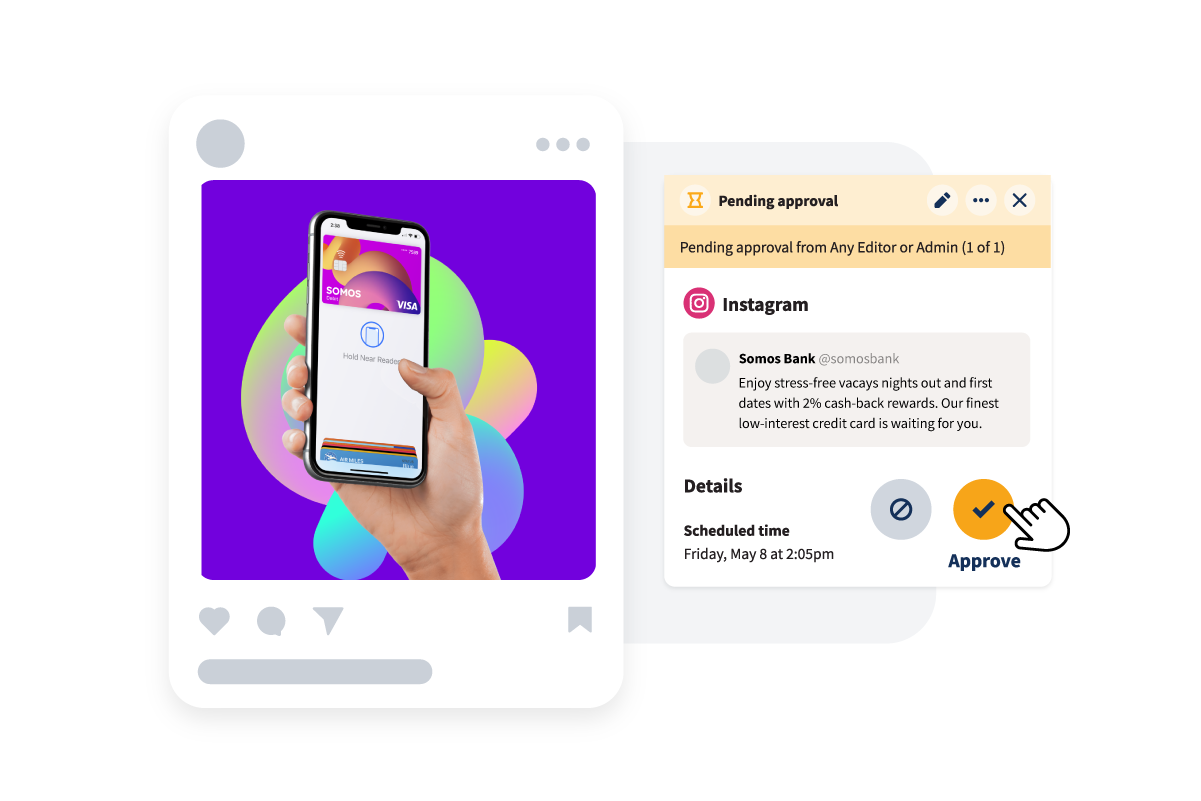
Approval workflows in Hootsuite Social OS help teams stay compliant while executing OKR-aligned content.
Connecting social activity to business outcomes
Hootsuite’s analytics don’t only count clicks. They connect them to conversions, leads, and brand sentiment, linking your social data to business KPIs so you can prove impact across the funnel. You can also use Wisdom AI to ask questions about your OKR progress and get contextual intelligence back in seconds.
Hootsuite analytics connect social metrics to business KPIs for OKR tracking.
FAQ: Social media OKRs for executives
What are social media OKRs for executives?
How do social media OKRs differ from team or operational OKRs?
What’s the difference between social media OKRs and KPIs?
Are OKRs still relevant in 2026?
Who should own executive social media OKRs?
How many OKRs should a social media team set per quarter?
How do you measure executive-level social ROI?
What are good KPIs for social media?
What tools help executives track social media OKRs?
How do enterprises scale OKRs across multiple markets?
Save time managing your social media marketing strategy with Hootsuite. Publish and schedule posts, find relevant conversions, measure results, and more â all from one dashboard. Try it free today.
The post Social media OKRs for executives: A complete framework for 2026 appeared first on Social Media Marketing & Management Dashboard.
br https://ift.tt/u5yNdBz
https://ift.tt/0zyNlXA
Comments
Post a Comment