Key takeaways
- Banks are shifting marketing budgets to digital. Nearly 62% of bank marketing spend now goes to online channels.
- Social media is a primary source of financial advice for younger generations. Many customers use social media to learn, research, and make decisions, making it a trust-building opportunity.
- Compliance and governance are non-negotiable. Banks need clear policies, approval workflows, and monitoring to use social media safely at scale. Tools like Hootsuite Social OS make this easier to manage.
- Choosing the right platforms and content types matters more than being everywhere. YouTube, LinkedIn, and Instagram consistently perform for banking audiences.
Why should banks be on social media?
Banks should be on social media because it’s where people learn about money, compare institutions, and figure out who they trust. Beyond visibility, an active social presence drives real business outcomes like lead generation, customer retention, and brand awareness.
Let’s take a closer look at why social media matters:
Social media is a go-to source for financial information
Social media is shaping how many investors, especially younger ones, make financial decisions.
According to research from the FINRA Foundation, 29% of investors say they use social media and message boards to get ideas for investing decisions.
Platforms like YouTube, Reddit, Facebook, and LinkedIn are the most popular for this kind of information.
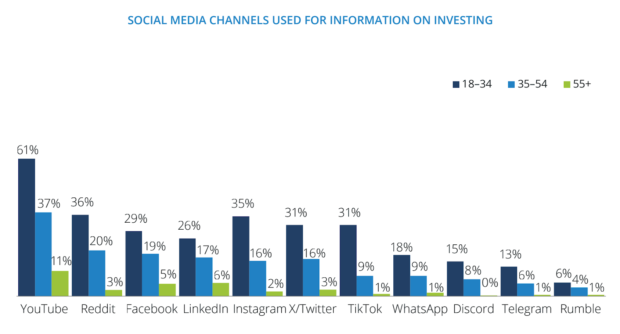
Source: FINRA Foundation
For banks, this comes with both opportunity and responsibility. Audiences are actively seeking financial education, but trust is fragile.
This is why clear, accurate, and transparent information matters more than ever, especially in regulated industries where credibility is everything.
Gen Z turns to social media for financial advice
For Gen Z, financial guidance lives on social media.
According to a recent poll from Gallup, 42% of Americans ages 18 to 29 say they turn to social media for financial advice. And 61% of investors under 35 have acted on recommendations from financial influencers.
Gen Z’s affinity for finfluencers isn’t a surprise. Financial influencers, especially those on TikTok, know how to deliver content that speaks to this generation.

Source: Vivian Tu / Your Rich BFF
Your bank’s social media strategy can take inspiration from their work, creating bite-sized videos focused on financial literacy, including advice and strategy.
Digital is now the primary channel for bank marketing
Digital is no longer “one channel.” It’s the channel in the banking industry.
Today, digital marketing represents nearly 62% of bank marketing budgets, making online channels the primary way banks reach, educate, and engage customers.
This means social media isn’t optional or experimental. It’s a core part of the marketing mix. With consumer banking digital ad spend reaching nearly $370 million per quarter, social media needs to play an active role in how banks show up.
Your competitors are already active on social
According to a 2023 ABA report, nine out of 10 banks say social media is important, and 88% report being very or somewhat active on their accounts.
If you’re not active online, your competitors are. They’re connecting with your potential followers and sharing why their bank is the right choice.
Bonus: Download a free bundle of social media tools designed specifically for financial services — including post ideas and templates for social media policies, strategies, and reports.
Which social media platforms are best for banks?
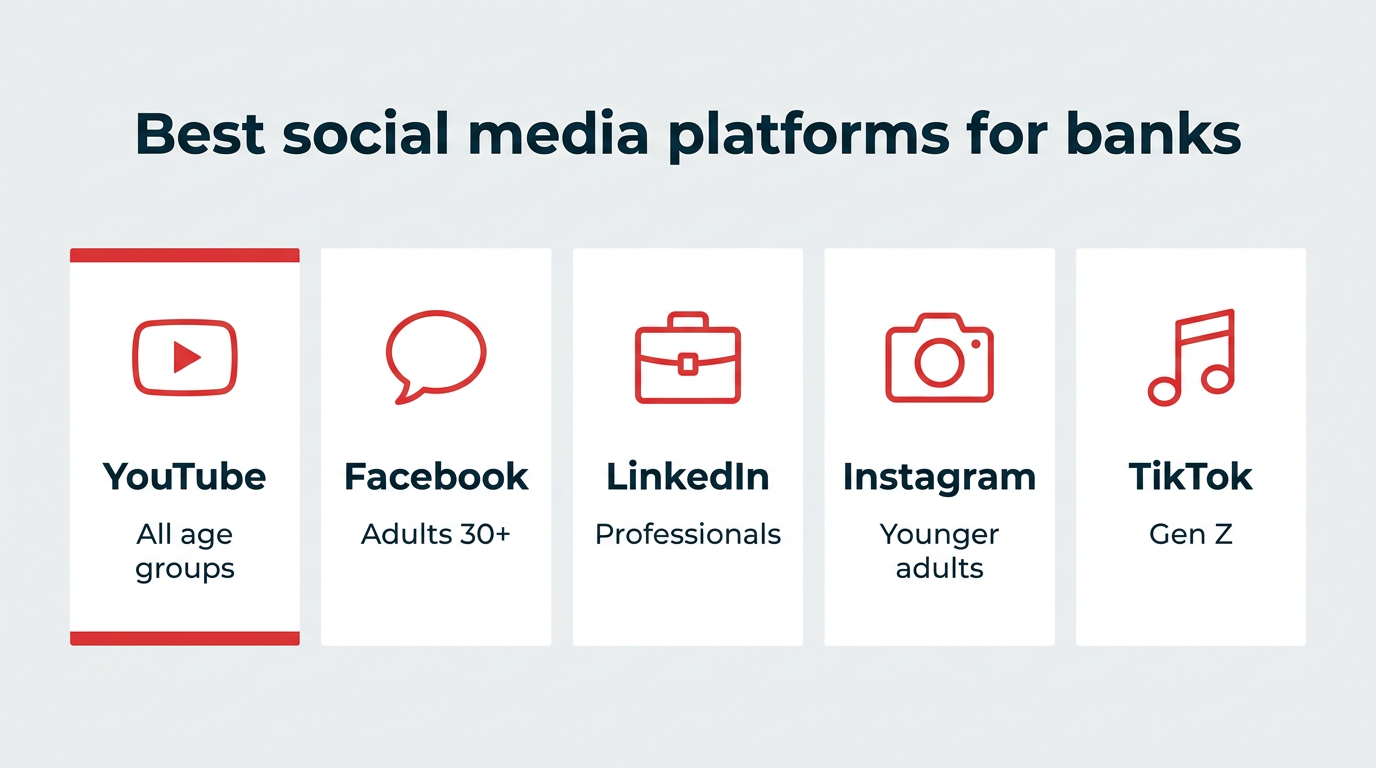
The best social media platforms for banks depend on your audience and goals, but YouTube, Facebook, LinkedIn, Instagram, and TikTok are the most commonly used. Platform choice should follow audience research, not trends.
“You can have the best product and content, but if you can’t distribute to your audience on the proper platform, you’re not going to hit your goal,” shares Leen Li, Chair of the Wealthsimple Foundation.
To find the right platforms, Li’s organization invested in paid content across YouTube, TikTok, and Instagram to “see what the first $1,000 could get us.” After crunching the numbers, the results clearly favored YouTube.
According to data from Pew Research Center, YouTube has the broadest reach across all age groups, with 95% of adults 18–29 using it, making it a strong foundation for most banks. Facebook, on the other hand, continues to offer solid reach among adults 30 and up.
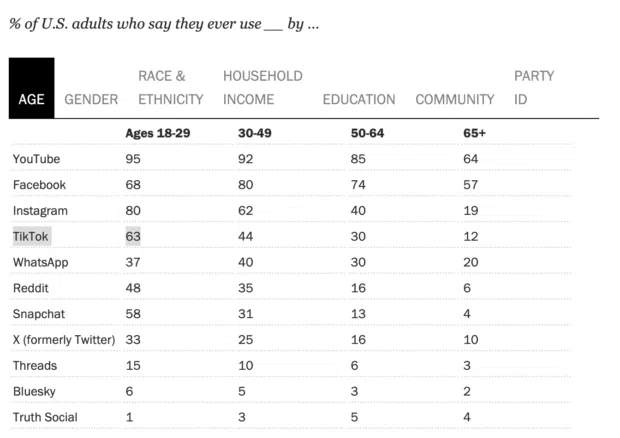
Gen Z, however, prefers bite-sized financial videos over booking an appointment with an advisor, making TikTok and Instagram smart investments for reaching them.
Here’s how the major platforms stack up for banks:
| Platform | Primary audience | Best content types | Banking use case |
|---|---|---|---|
| YouTube | All age groups | Long-form video, webinars, explainers | Broad reach, financial education |
| Adults 30 and up | Updates, community posts, links | Local engagement, older customers | |
| Professionals, older adults | Thought leadership, hiring, B2B | Brand authority, recruitment | |
| Younger adults | Reels, carousels, stories | Financial literacy, brand awareness | |
| TikTok | Gen Z, younger millennials | Short-form video, finfluencer content | Reaching younger audiences |
You don’t need to be everywhere. Instead, show up where your audience already spends time, with content that matches how they prefer to learn and engage.
What kind of content should banks post on social media?
Banks should post content that educates, builds trust, and shows the human side of the institution, not just product promotions. A strong content mix keeps audiences engaged while giving them reasons to trust you with their money.
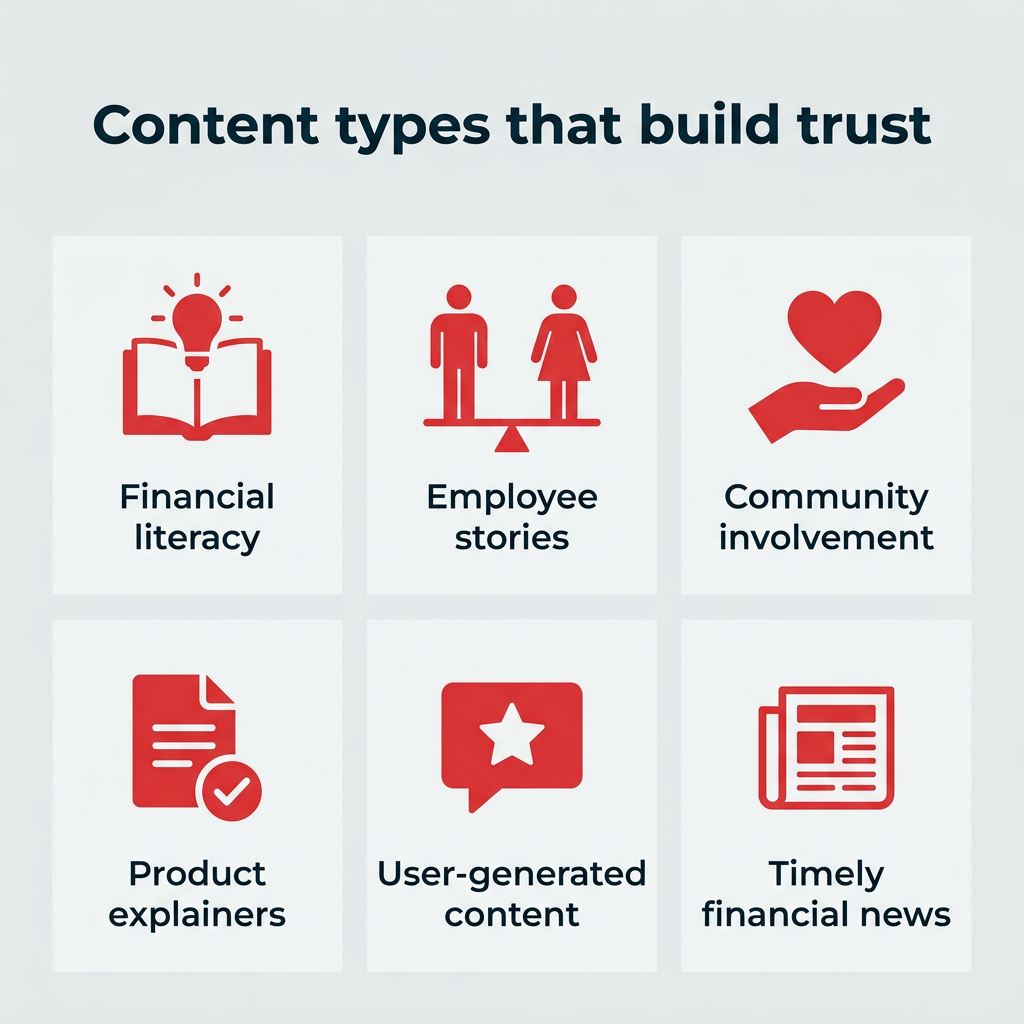
Here are the content types that work well for social media marketing for banks:
- Financial literacy and education: Bite-sized tips, explainers, and how-to videos that help people make better money decisions.
- Behind-the-scenes and employee stories: Content that puts a face to your brand and shows the people behind the institution.
- Community involvement: Highlights of local sponsorships, volunteering, and social good initiatives.
- Product explainers: Clear, jargon-free breakdowns of accounts, loans, and services.
- User-generated content (UGC): Real customer stories and testimonials that build credibility.
- Timely financial news: Neutral, helpful updates on rates, deadlines, or market events your audience cares about.
The finfluencer dynamic is worth learning from here. Creators earn attention because they lead with education and personality, not sales pitches. Banks can borrow that approach with short-form video, carousels, and threads.
User-generated content can go a long way in building trust. Securian Financial‘s #LifeBalanceRemix campaign, for example, boosted community engagement with UGC while achieving serious results.

Source: jaredspurgeon46
Using a mix of social listening, UGC, and social engagement, the campaign saw:
- 2.5M impressions on X and Instagram
- 1,000+ participants contributing content
- $35,000+ return on investment
How to do social media for banks: 9 tips
Check out these nine tips for running an effective and compliant bank social media strategy:
- Start with a social media audit
- Use social media to build trust through education
- Stay on top of compliance and risk management
- Educate your internal team
- Put a social media governance policy in place
- Connect social media to your broader marketing strategy
- Humanize your brand with people-forward content
- Prepare for social media crises
- Engage with your audience
1. Start with a social media audit
To get a full picture of what you’re working with, do a social media audit.
Global insurance giant MAPFRE, for example, conducted a social media audit and discovered over 80 official social media pages spread across different platforms.

Source: MAPFRE
By consolidating these accounts into one platform using Hootsuite, they gained a clearer view of their social media activity and significantly boosted their online presence.
The results were impressive:
- 2M+ followers on social networks
- 31% increase in online interactions
- 200M+ comments received per year
2. Use social media to build trust through education
Trust is a big deal for Gen Z, especially when it comes to money.
According to the World Economic Forum, 17% of non-investors say it’s because they have difficulty trusting financial institutions. Yet many say they would invest more if they had better opportunities to learn.
At the same time, Gen Z tends to trust people, not logos. They’re also very skeptical of finfluencers who try to sell them something.
For banks, the takeaway is simple. Whether you’re partnering with a creator or publishing from your brand account, don’t shy away from personal stories and practical insights. Focus on education first.
One growing consideration in 2026 is transparency around AI-generated content. Being upfront about how you use AI in customer-facing content helps protect brand reputation in a low-trust environment.
And remember: trying to teach and sell in the same breath can break trust fast.
3. Stay on top of compliance and risk management
Where you operate will dictate which compliance and risk management rules you need to follow. Highly regulated industries like finance can face serious legal and financial consequences if compliance isn’t properly managed across social media initiatives.
Several regulatory bodies shape what banks can and can’t do on social media. FINRA and the SEC govern investment-related communications, the OCC oversees national banks, and the FDIC sets expectations around advertising and consumer protection. Sharing customer information or making unsubstantiated claims can lead to penalties, not just reputational damage.
A security breach, whether from unauthorized social media activity or cyber attacks, can result in major financial and reputational damage.
For example, financial technology service provider SIX (operating in Switzerland) manages services for 130 banks. With such a big network, the company is highly susceptible to cyber threats, especially across social media platforms that require constant vigilance.

Source: sixgroup
To combat this, SIX implemented automated cyber security measures (powered in part by Hootsuite) to monitor and address threats, such as unauthorized profiles or malicious content. Within Hootsuite Social OS, Vigil provides the governance layer for approvals and archiving, while Lumen supports real-time monitoring.
The results speak for themselves:
- 30-40 automated alerts generated per month
- 1-2 non-compliant content takedowns a month made possible
- < 24 hour content takedown time achieved
And speaking of compliance: We’ve already mentioned FINRA a few times, so here are some tips to stay compliant with them and tips on staying compliant with the SEC on social media.
4. Educate your internal team
Include a phase in your social media strategy dedicated to educating your internal team on your industry’s regulations and your own social media guidelines.
If your team members understand what compliance looks like, they will be far less likely to accidentally post something that may get you in trouble.
Hootsuite can also make this easier. Parliament, our employee advocacy platform within Hootsuite Social OS, allows content admins to push a steady stream of pre-approved, curated content that your employees can share on their social accounts.
Parliament is a great way to extend your organization’s reach while reducing risk with on-brand, compliant social media posts. We use it ourselves, and we’ve also introduced an educational component into the strategy.

After implementing it, we saw impressive results:
- 250% YOY increase in sourced revenue
- 86% Parliament sign-up rate — up 8% YOY
- 4.1M employer brand impressions in Q1 attributed to employee posts
5. Put a social media governance policy in place
A social media governance policy lays out the rules of engagement for all employees. This can be a document outlining all of the “needs to know” for your content creators.
At a minimum, a strong governance policy should include:
- Content approval workflows: Who reviews and signs off on posts before they go live.
- Response time standards: How quickly your team should reply to comments and messages.
- Escalation procedures: Clear paths for handling complaints, complex questions, or potential crises.
- Archiving and record-keeping: How posts and interactions are stored to meet regulatory requirements.
- Employee social media use guidelines: Rules for how staff represent the brand on personal and professional accounts.
Your policy should align with your guidelines for email, text, and all other communications with clients and the public. Overall, it will help you operate within your industry’s regulations.
Since social media management is part of the company’s overall security and compliance policies, the chief information officer and chief risk officer may be involved in creating social media policies. Vigil, the governance layer in Hootsuite Social OS, helps enforce these rules consistently across teams.
Hootsuite can even partner with you to deliver custom social media governance training for your employees.
6. Connect social media to your broader marketing strategy
Investors in younger generations (aged 18-34) aren’t exclusively relying on social media for financial advice. They use it in conjunction with other sources to gather information.

Source: vancitycu
So, creating a network of digital information (like linking your social posts back to your blog and from your blog to vetted sources) will help you build a reliable reputation.
This can be as simple as adding a CTA like, “click the link in our bio.” Hootsuite Social OS makes this easier by connecting social data to your broader marketing stack, including Salesforce and Adobe integrations, so your teams work from connected systems.
7. Humanize your brand with people-forward content
You can improve your social media engagement by posting about the people within your company. Share employee stories, your client’s experiences and testimonials, and behind-the-scenes updates.
You’ll give off the impression that you care about the people who work within your organization, which is important in an industry often seen as impersonal.

Source: Kennebec Savings Bank
Your efforts to humanize your brand will pay off. For example, Julius Baer, a leading Swiss private banking group, used Parliament to empower employees as brand ambassadors.
This boosted the firm’s reach and reputation with:
- 12,500 website clicks from employee posts
- 5.3M LinkedIn impressions from employee content
- 160,000 CHF in potential ad value created through employee advocacy
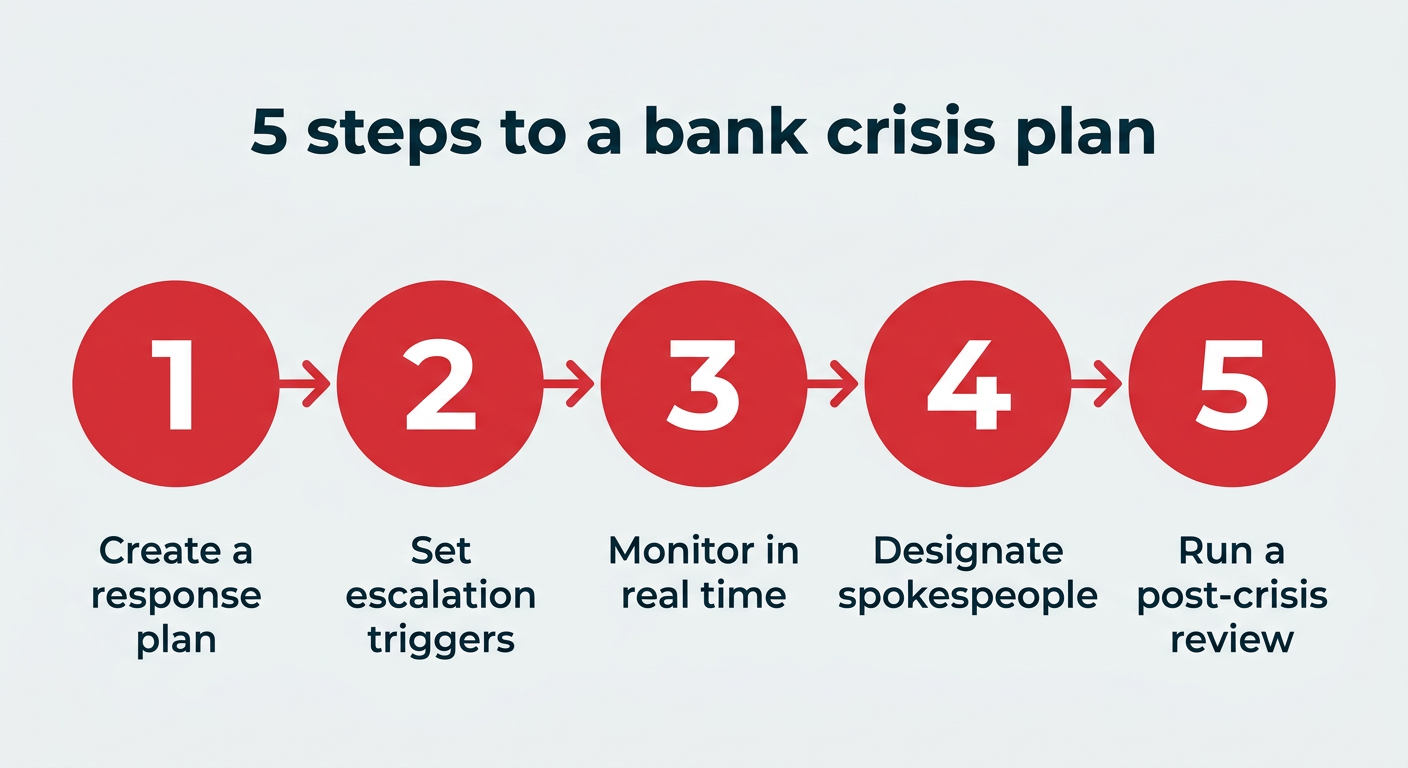
8. Prepare for social media crises
Banks face unique reputational risks, so a crisis plan isn’t optional. A single mishandled comment or unauthorized post can escalate quickly in a regulated industry.
Here’s how to prepare, step by step:
- Create a response plan: Document who does what, and draft holding statements for common scenarios.
- Identify escalation triggers: Define what turns a routine complaint into a crisis that needs leadership involvement.
- Monitor brand mentions in real time: Use monitoring tools like Lumen to catch issues early.
- Designate spokespeople: Decide in advance who is authorized to speak publicly during a crisis.
- Conduct a post-crisis review: Analyze what happened and update your plan so you respond faster next time.
A clear plan keeps your team calm and consistent when it matters most.
9. Engage with your audience
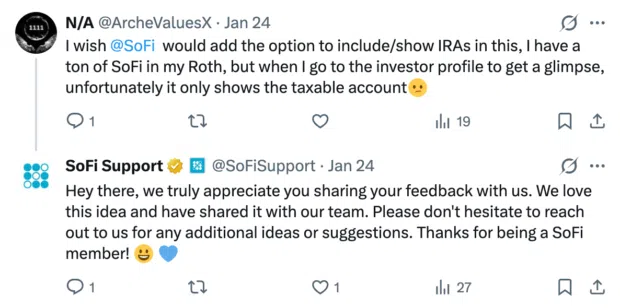
The beautiful thing about social media is that it’s a two-way street, and a powerful way to improve customer experience. People are reaching out to you who want to engage and have a conversation.
Good customer service isn’t just about fielding complaints, either. Being open and receptive to talking with your audience humanizes your institution and helps build customer loyalty.
Source: SoFi
Respond to posts and threads, engage with comments on Instagram, TikTok, and LinkedIn, and reply to direct messages. Nest, the unified inbox in Hootsuite Social OS, brings every conversation into one place so your team can respond quickly and consistently.
Social media examples from banks worth following
Looking at real bank social media examples is one of the best ways to spark ideas for your own strategy. Here are a few financial institutions doing it well and what makes their approach effective.
- Bank of America: Leans heavily into financial literacy, publishing accessible educational content that answers the questions real customers ask.
- Kennebec Savings Bank: Uses people-forward, community-focused content to show the human side of a local institution, as seen in the behind-the-scenes example above.
- SoFi: Excels at customer engagement, using responsive, conversational support to build loyalty across platforms.
- MAPFRE: Demonstrates how a large, global brand can consolidate dozens of accounts into a consistent, high-performing social presence.
The common thread is clear. These brands lead with education, personality, and responsiveness rather than constant promotion.
How to measure social media success for banks
Banks measure social media success by tracking the right metrics, using tools built for regulated industries, and regularly adjusting based on performance.
Here’s how to do that in practice:
Use the right tools
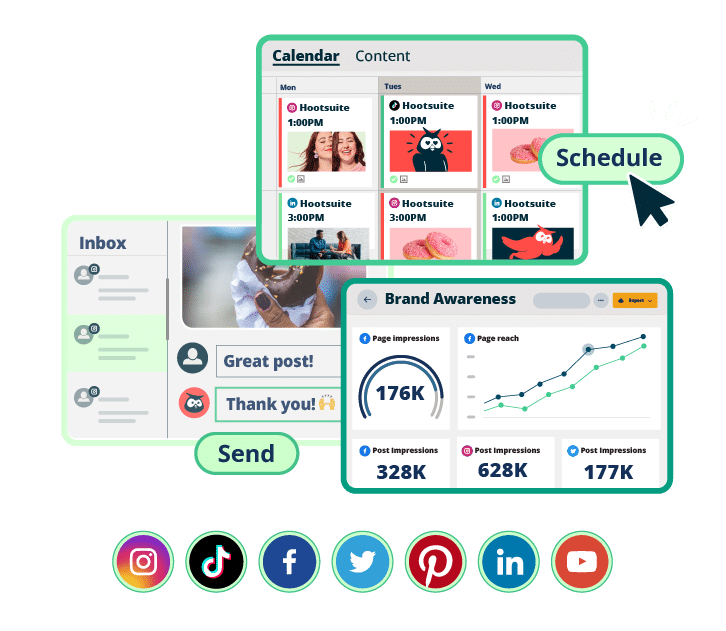
Hootsuite Social OS helps credit unions, banks, and other financial institutions measure and manage every aspect of their social media presence from one social operating system.
You can get help with scheduling, reporting, and creating compliant content for credit unions and banks.
Analytics gives you an overall view of what’s working and what’s not, but there are other apps the financial sector loves:
- Perch (publishing): Plan and schedule posts across multiple platforms to stay consistent. You can reach your audience at optimal times using the best time to publish tool, even across different time zones.
- Benchmarking: Compare your performance against competitors and industry standards. You can do this using Hootsuite or check out our complete guide to social media benchmarks for financial services (it’s updated quarterly).
- Lumen (social listening): Monitor what people are saying about your brand, competitors, and industry trends in real time. This helps you stay proactive in managing your reputation and addressing concerns before they escalate.
- Nest (community management): Manage customer inquiries and responses from one place, helping you keep communication consistent.
- Vigil (compliance and risk management): Vigil helps keep your content compliant with financial regulations while protecting your brand from cyber threats. Learn more about ways to protect your brand.
Grow your client base with the tool that makes it easy to sell, engage, measure, and win — all while staying compliant.
Book a DemoTrack the right metrics
To gauge the effectiveness of your social media efforts, focus on key performance indicators (KPIs) that align with your business goals.
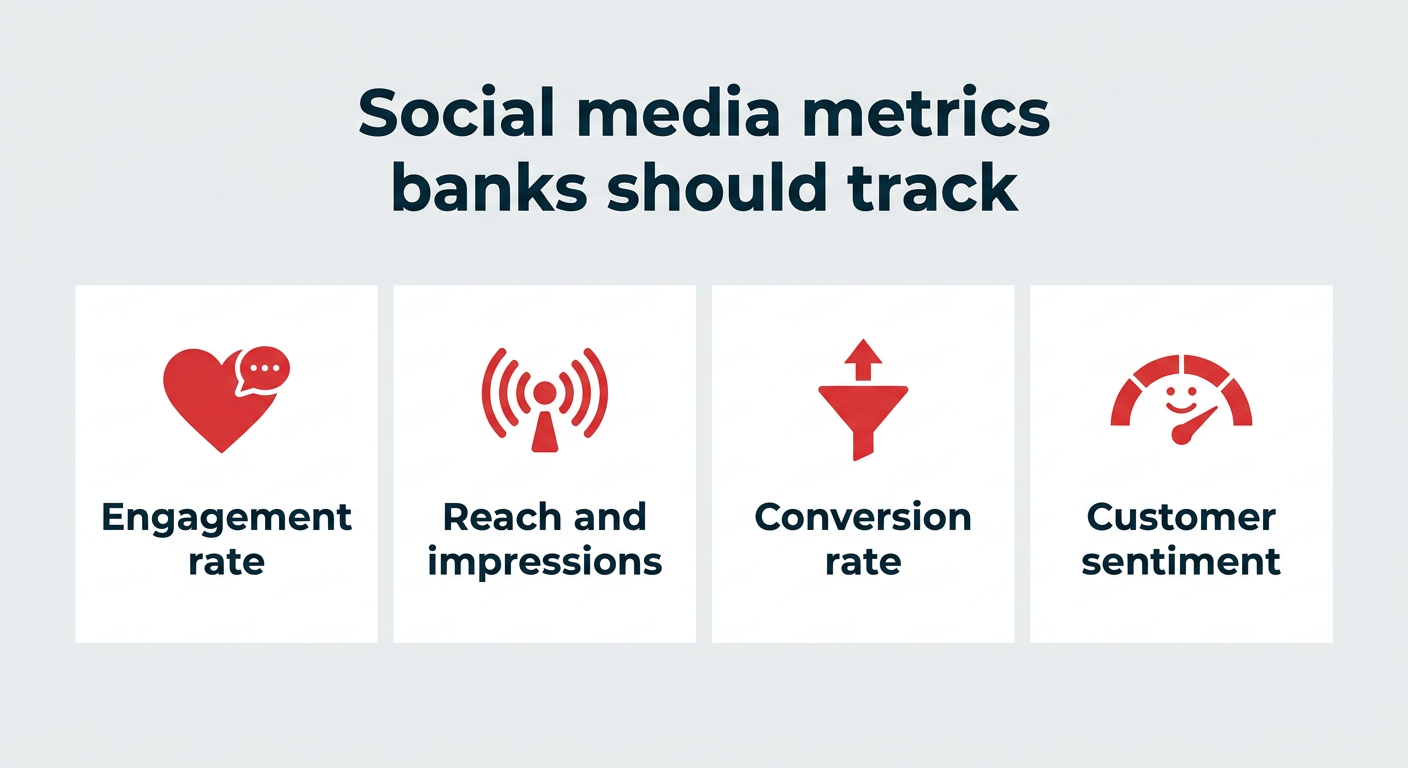
Here are a few popular metrics you might want to consider:
- Engagement rates: Likes, comments, shares, and mentions. If you need a quick reference, bookmark this page for updates on the average engagement rates for financial services.
- Reach and impressions: How far your content is spreading and how many people are seeing it.
- Conversion rates: The percentage of social media interactions that lead to a desired action, like clicking a link or signing up for a service.
- Customer sentiment: Measure how people feel about your brand through comments, reviews, and social mentions.
Review results and adapt your strategy
The social strategies that work are the ones that are regularly reviewed and adapted. Take a look at your metrics using Hootsuite Analytics to see what’s working and what’s not, and adjust your budget and strategy accordingly.
If a particular type of content performs better, lean into that. If engagement drops, reassess your approach. Your data is the best indicator of what’s working, letting you adjust your strategy for the best results and best use of your social media budget.
FAQ: Bank social media
How do banks use social media safely and compliantly?
What are the best social media practices for banks and financial institutions?
What social media platforms are best for banks?
How do banks manage social media risk and compliance?
What is a good social media strategy for a bank?
How do banks use social media?
What kind of content should banks post on social media?
Can banks use social media for lead generation?
How often should banks post on social media?
What are the biggest social media risks for banks?
Save time managing your social media marketing strategy with Hootsuite. Publish and schedule posts, find relevant conversions, measure results, and more â all from one dashboard. Try it free today.
The post Bank social media: 9 tips to boost trust and engagement in 2026 appeared first on Social Media Marketing & Management Dashboard.
br https://ift.tt/uOz5dfm
https://ift.tt/bjgvy3Y
Comments
Post a Comment