Key takeaways
- Social media optimization improves reach, engagement, and conversions. It works by refining your profiles, content, and posting strategy based on data, not guesswork.
- Discoverability is now driven by social search. Keywords, hashtags, and profile optimization matter more than ever as people search directly inside social apps.
- A structured approach covers five areas. Optimize for engagement, growth, conversions, accessibility, and overall performance rather than chasing one metric.
- Scaling optimization requires centralized tools. Managing posting times, hashtags, analytics, and content across networks from one platform saves time and improves consistency.
What is social media optimization?
Social media optimization is the process of improving your social media content, profiles, and strategies to achieve better results: faster follower growth, higher levels of engagement, more clicks or conversions, and so on.
SMO covers both the small, tactical improvements you make to individual posts and the bigger strategic decisions behind your presence, like which platforms you invest in and what your content mix looks like.
Common tactics of social media optimization include:
- Basic improvements to individual posts, such as adding a call-to-action in a caption or picking a scroll-stopping visual
- Larger strategic improvements, like redefining your brand’s tone of voice on social media
- Optimizing posting times and frequency based on audience behavior
- Improving discoverability, such as adding keywords to bios and captions so your content surfaces in social search
That last point matters more each year. Social platforms increasingly function as discovery and search engines, so optimization is no longer just about pleasing a feed algorithm. It’s about being findable.
In any case, social media optimization should be based on performance analysis, audience research, and insights gathered through social listening.
How does social media optimization relate to SEO?
Social media optimization and SEO share the same goal: making your brand easier to find. The difference is where that discovery happens. SEO improves your visibility in search engines like Google, while SMO improves your visibility inside social platforms, in feeds, recommendations, and in-app search.
The two also support each other. Social content can drive branded searches, earn links when other sites pick up your posts, and extend the life of blog content you’ve already optimized. And because platforms like TikTok and Instagram now behave like search engines themselves, many of the same habits apply: research what people are looking for, use their language, and structure content so it’s easy to categorize.
| Social media optimization (SMO) | Search engine optimization (SEO) | |
|---|---|---|
| Focus | Visibility and engagement on social platforms | Rankings and traffic from search engines |
| Where it happens | Instagram, TikTok, LinkedIn, Facebook, X, Threads | Google, Bing, and other search engines |
| Key tactics | Profile and caption keywords, hashtags, posting times, formats, engagement | Keyword research, on-page content, technical health, backlinks |
| How you measure it | Reach, engagement rate, follower growth, social referral traffic | Impressions, rankings, organic sessions, conversions |
In short, treat SMO and SEO as two halves of the same discoverability strategy rather than competing channels.
What are the benefits of social media optimization?
With nearly 5.75 billion social media users worldwide in 2026, social media optimization helps your content reach the right people and actually perform once it gets in front of them. When your posts are easier to discover and more relevant to your audience, everything works better, from reach to engagement to conversions.
Here are some of the biggest benefits:
- Grow your followers faster: Optimized posts are easier to discover, which means more people find (and follow) your brand.
- Understand your audience better: Audience analytics and social listening reveal what your audience actually cares about, not just what you think they care about.
- Increase brand awareness: When your content performs better, more people see it. That naturally boosts brand awareness.
- Improve reach on social media: Optimization helps your posts surface in feeds, recommendations, and social search results.
- Lead generation: The right content attracts the right audience, which means better leads.
- Sell more products or services: Clear messaging and stronger engagement can turn attention into sales.
- Increase engagement rates: Optimized posts are more likely to spark likes, comments, shares, and real conversations.
When your posts are optimized for discovery, relevance, and performance, it becomes much easier to grow your audience and turn attention into real business impact.
How should you start optimizing social media?
Before you change anything, get a clear picture of where you stand. A social media audit gives you the baseline you’ll measure every optimization against, and it usually surfaces a few easy wins on its own.
Here’s a simple five-step audit to run before you start tweaking:
- Inventory your accounts. List every active (and inactive) profile, including any imposter or legacy accounts you need to claim or shut down.
- Check profile completeness. Confirm bios, links, handles, profile images, and contact details are current and consistent across networks.
- Benchmark your current metrics. Record reach, engagement rate, follower growth, and referral traffic for the past 90 days so you have a before snapshot.
- Identify your top and bottom performers. Look for patterns in format, topic, and posting time among your best and worst posts.
- Assess your competitors. Note how often they post, what formats they lean on, and where their engagement is coming from.
Need a template and a deeper walkthrough? Start with our guide to running a full social media performance review.
What are the best social media optimization tactics for 2026?
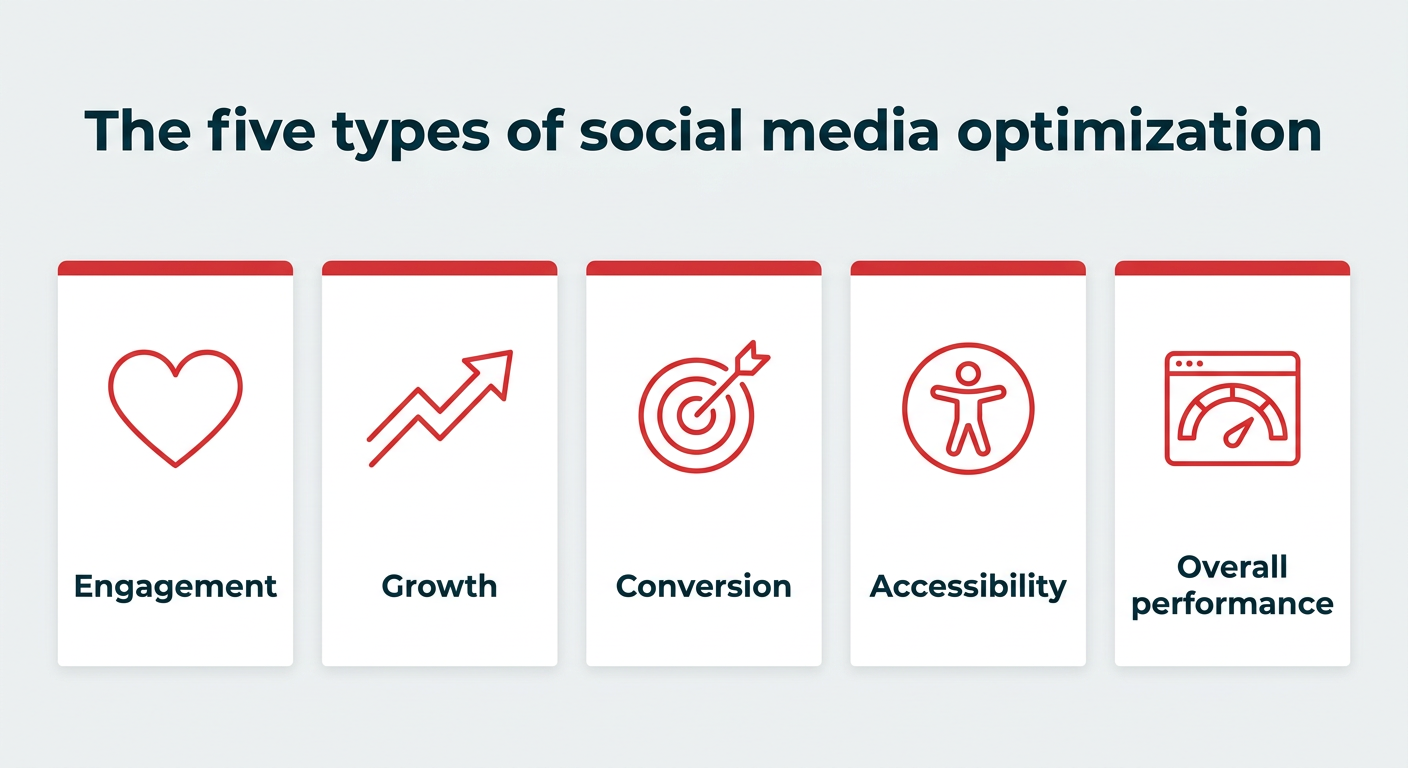
Social media optimization can be divided into five types:
- Engagement optimization
- Growth optimization
- Conversion optimization
- Accessibility optimization
- Overall performance optimization
Here’s a quick look at the 15 tactics we’ll cover under those five categories:
- Post at the right times
- Ask questions and use interactive formats
- Lean into short-form video and visual formats
- Follow a content mix framework
- Post the right amount of content
- Engage with your audience in the comments
- Optimize your bio for search
- Include relevant keywords in your captions
- Add the right hashtags to your posts
- Tag accounts and leverage user-generated content
- Learn from your competitors
- Include a CTA and link in your bio
- Optimize your links with UTMs
- Make sure your images are the right size
- Add alt text and captions to visual content
Let’s break down how to optimize for each type.
Engagement optimization
Engagement optimization is about giving people a reason to stop, react, and reply. These tactics focus on timing, format, and conversation, the three things that most reliably lift engagement rate.
1. Post at the right times
Posting at the right time increases the likelihood that your audience will see and engage with your content.
There are certain times of the day that your audience is more likely to be online, but figuring out those special windows isn’t easy. Especially when audience habits vary from industry to industry.
Luckily, we’ve done the research to determine the universal best times to post on social media. Here’s the breakdown by platform:
| Platform | Best time to post |
|---|---|
| Tuesday, 9AM | |
| Monday, 3PM-9PM | |
| X (Twitter) | Wednesday, Thursday, and Friday, 9AM-11AM |
| Tuesday and Wednesday, 4AM-6AM | |
| TikTok | Thursday, 7AM-11AM |
These times provide a helpful baseline, but every audience behaves differently. Industry, geography, and follower habits can all influence when your posts perform best. The same goes for newer networks like Threads, where your own data will always beat a universal benchmark.
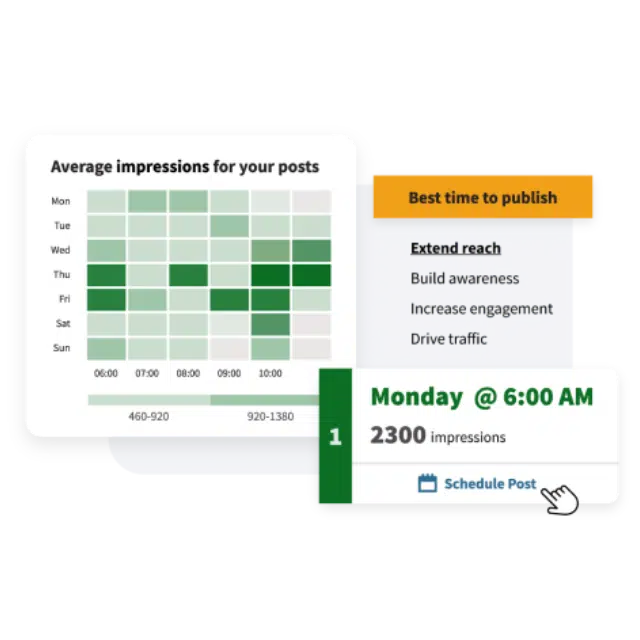
Find out when your audience is online and optimize your posting schedule for maximum engagement. It’s so easy.
Start your free trial2. Ask questions and use interactive formats
Asking questions is one of the easiest engagement hacks. But the trick is to only ask questions that your audience would actually care to answer in the comments.
Interactive formats do the same job with less friction. Try a question sticker in an Instagram story, run a poll, add a quiz or slider sticker, or simply pose some food for thought in your caption. Each one gives people a low-effort way to respond, which is exactly what feed algorithms reward.
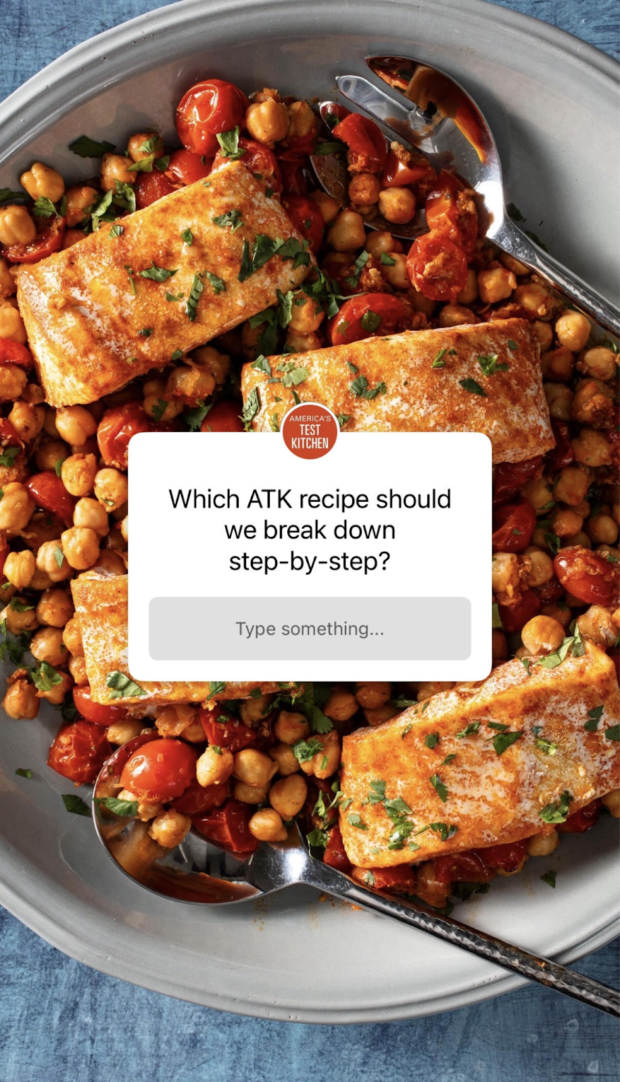
Source: America’s Test Kitchen
3. Lean into short-form video and visual formats
Strong visuals are the backbone of social media. Eye-catching images and videos stop people long enough to engage.
Short-form video is the format doing the heaviest lifting right now. Reels, TikToks, and YouTube Shorts — which alone average 200 billion daily views — get surfaced to non-followers more aggressively than most other formats, which makes video one of the fastest ways to expand reach beyond your existing audience.
Carousels are the other strong performer. According to research from Hootsuite, Instagram posts average a 3% engagement rate across all post types, ahead of Instagram Reels at 2.7% — so it’s worth keeping feed formats like carousels in your rotation alongside video.
The same pattern shows up on other networks that support carousels, like LinkedIn, Facebook, and X. The temptation to swipe left, it seems, is hard to resist, especially when there’s a persuasive cover slide.
The optimization takeaway isn’t to pick one winner. It’s to keep a mix of video, carousels, and static posts in rotation so you’re not over-indexed on a single format if the algorithm shifts. The 2026 social trends report tracks which formats are gaining and losing ground across platforms.
4. Follow a content mix framework
If every post sells something, engagement drops fast. A content mix framework gives you a simple ratio to keep promotion in check and value front and center.
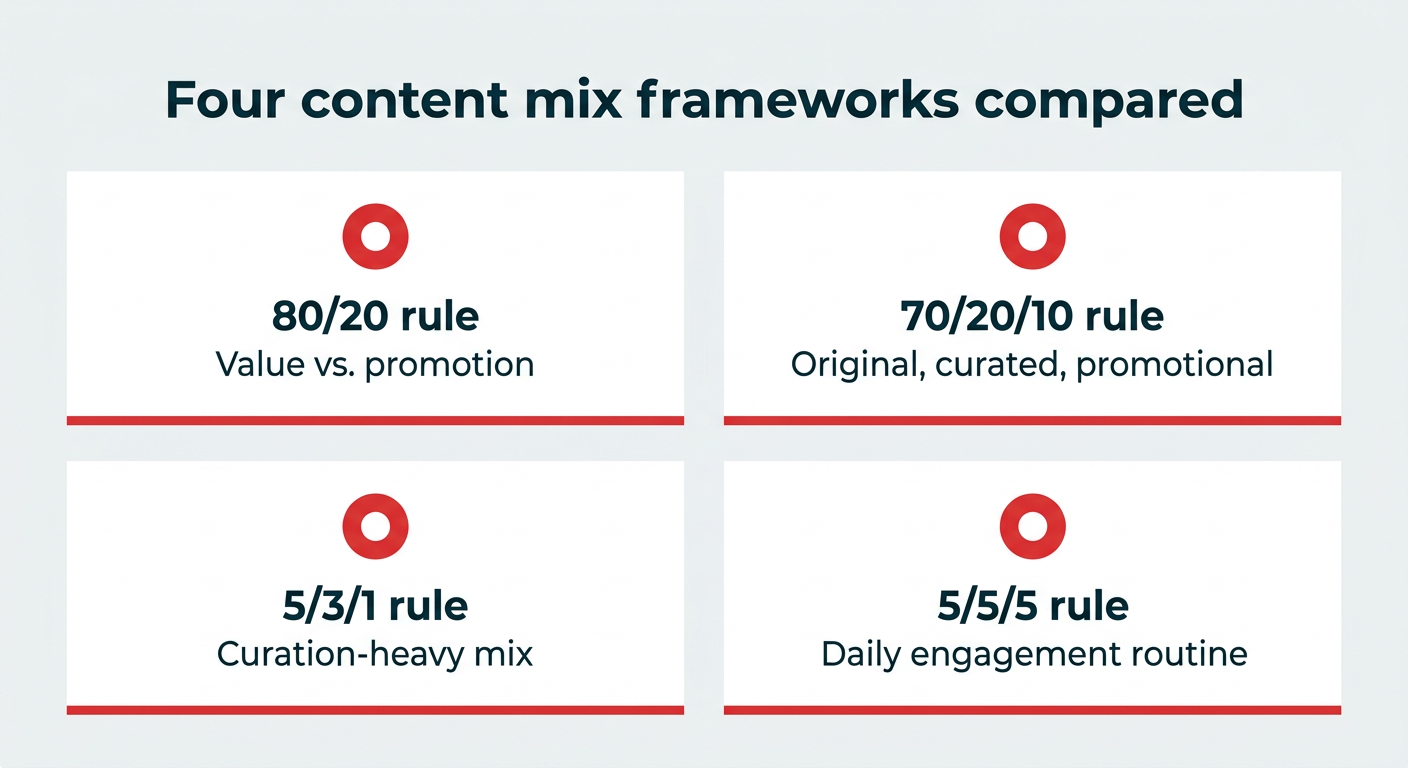
Here are the four frameworks marketers reference most:
- The 80/20 rule: 80% of your posts inform, educate, or entertain. 20% directly promote your business.
- The 70/20/10 rule: 70% of posts build your brand or add value, 20% are shared or curated from other sources, and 10% are promotional.
- The 5/3/1 rule: For every nine posts, five are curated from other sources, three are original content, and one is promotional.
- The 5/5/5 rule: An engagement routine rather than a posting ratio. Spend five minutes liking posts, five minutes commenting, and five minutes sharing content from others in your niche.
| Framework | What it balances | Best for |
|---|---|---|
| 80/20 | Value vs. promotion | Brands starting from scratch who need a simple guardrail |
| 70/20/10 | Original, curated, and promotional content | Teams publishing daily across several networks |
| 5/3/1 | Curation-heavy mix | Thought leadership and industry accounts |
| 5/5/5 | Daily engagement effort | Community building and creator accounts |
None of these are rules in a strict sense. Pick one as a starting point, track your engagement rate for a month, and adjust the ratio based on what your audience actually responds to.
5. Post the right amount of content
Finding your optimal social media posting schedule is essential to driving more audience engagement.
Here’s how often you should post to the biggest social media sites, according to experts:
- On Instagram, post between 3-5 times per week.
- On TikTok, post between 3 to 5 times per week.
- On X (Twitter), post between 2 and 3 times a day.
- On Facebook, post between 1 and 2 times a day.
- On LinkedIn, post between 1 and 2 times a day.
Remember that finding the sweet posting spot might take some time. Experiment and find what cadence works best for you, and prioritize consistency over volume if your team is stretched thin.
6. Engage with your audience in the comments
Publishing is only half the job. Replying to comments keeps conversation going under your post, which signals to the algorithm that the content is worth showing to more people.
A few habits that make this manageable:
- Reply early: Aim to respond within the first hour or two after publishing, when engagement momentum matters most.
- Ask a follow-up question: A reply that ends with a question keeps the thread alive instead of closing it.
- Move sensitive issues to DMs: Acknowledge complaints publicly, then take the details to a private message where you can resolve them properly.
- Engage outside your own posts: Comment on partner, creator, and customer content so your brand shows up in more feeds than your own.
Treat the comments section as part of your publishing workflow, not an afterthought, and you’ll see the difference in both reach and sentiment.
Growth optimization
Growth optimization is about being found by people who don’t follow you yet. Most of it comes down to discoverability: keywords, hashtags, tags, and a profile that makes the follow decision easy.
7. Optimize your bio for search
Your social media bio is one of the first things people see when they land on your profile. So, it’s essential to optimize it.
Use your social media bio to clearly explain:
- Who you are
- What your business does
- What you do
- The topics that interest you
- Your brand’s tone (more on this below!)
- How someone can get in touch with you
Your bio is also a chance for you to state why someone should even consider following you. Take Hootsuite’s X bio, for example.

On every platform, we tell followers exactly what they’ll get: social media tools, tips, news, and resources. If you work in social, it’s clear why we think you should follow us.
Your bio also plays an important role in social search. Platforms now behave like search engines, so including relevant keywords can help new users discover your profile.
For example, a travel company could include keywords like “travel,” “vacation,” or “travel tips” in its bio to improve discoverability.
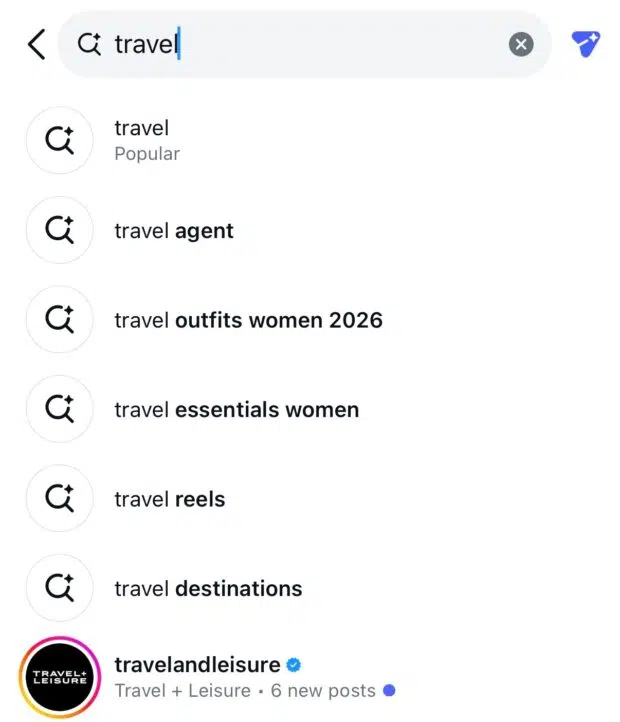
Here are a few more quick tips for optimizing your bio:
- Include your location
- Include your primary keyword in your username (i.e., “@shannon_writer”)
- Include hashtags you use frequently or branded hashtags your business has created
Psst: Read more tips for SEO on Instagram.
8. Include relevant keywords in your captions
Adding keywords to your captions is an important play for discoverability.
Gone are the days of the one-word caption. Most social media platforms, including Instagram, now recommend including relevant keywords in post captions to help with discoverability.
Part of the reason is behavioral: Ipsos research found 93% of daily TikTok users would use the platform to research products before buying, and plenty of people now open TikTok or Instagram to search for a recipe, a product review, or a local business instead of heading to Google. Platforms also read caption text to categorize your content and decide who to recommend it to, so the words you choose shape your reach.
This is great news for lesser-known brands, since it gives people a better chance to find your content without searching for your specific account name.
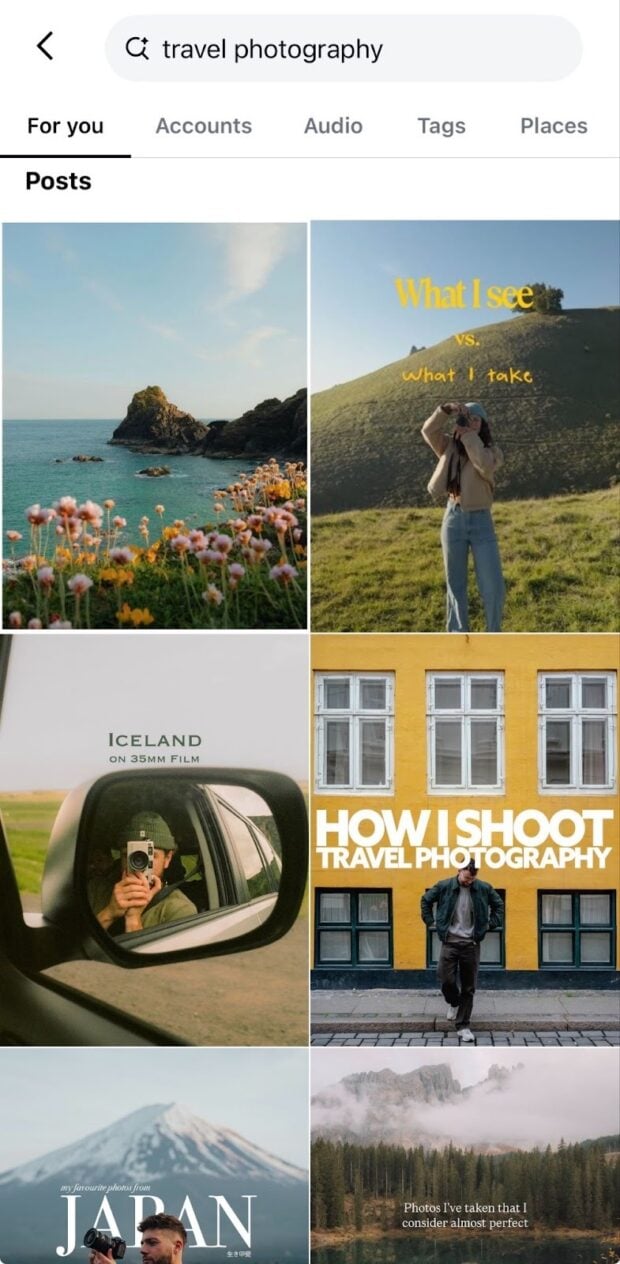
But don’t just write a novel stuffed with keywords. It should still feel natural. Captions packed with unrelated keywords can appear spammy to both users and platform algorithms.
So, how do you choose your target keywords?
Analytics tools will give you more insight. For example, use Google Analytics to see which keywords are already driving traffic to your website. These keywords are strong candidates to test in your social media captions. You can also use a social SEO caption tool to generate keyword-rich captions faster.
9. Add the right hashtags to your posts
Adding relevant hashtags is another common optimization technique for improving content discoverability.
Marketers have been using and abusing hashtags for many years (who among us hasn’t tried hiding 30 hashtags in the comments of their Instagram post?).
These days, the platforms themselves are offering clearer guidance. Here are a few guidelines to keep in mind for your hashtag strategy:
- Put hashtags directly in the caption
- Use only relevant hashtags
- Mix popular, niche, and branded or campaign hashtags
- Limit hashtags to 3–5 per post
- Avoid overly generic hashtags like #explorepage, which may get flagged as spam
While these tips come from Instagram, the same logic applies across most social networks. Nearly every platform has published similar advice.
Want to dig deeper? Check out our guides on:
If coming up with the perfect hashtags for every post sounds like a lot of work, you’re not alone. A free hashtag generator can give you a quick starting point.
All you have to do is click on the suggestions you like to add them to your post. You can then publish it or schedule it for later.
10. Tag accounts and leverage user-generated content
If your post features another brand, creator, or customer, tag them.
Not only is it good posting etiquette, but it can also expand your reach. Tagged accounts often reshare posts with their own followers, giving your content visibility beyond your own followers.
The same logic makes user-generated content (UGC) such a strong optimization play. Customer photos, reviews, and unboxing videos carry more trust than polished brand creative, and resharing them gives the original creator a reason to amplify your post. A simple, repeatable approach: create a branded hashtag, monitor who uses it, ask permission, then reshare the best submissions to your feed or stories.
And remember: always make sure you credit and tag the original creator. That’s a golden rule on social.
11. Learn from your competitors
Your competitors are running experiments you don’t have to pay for. Watching what works for them is one of the fastest ways to spot gaps in your own strategy.
Focus your review on four things:
- Posting frequency and timing: How often they publish, and when their strongest posts go live.
- Content formats: Whether their reach is coming from short-form video, carousels, or text posts.
- Engagement patterns: Which topics consistently pull comments and shares, and which fall flat.
- Keywords and hashtags: The terms they’re targeting in bios and captions, and the gaps they’re leaving open.
The goal isn’t to copy. It’s to find the topics and formats your category is underserving so you can claim them first. Our guide to benchmarking against rival brands walks through the full process.
Conversion optimization
Conversion optimization is where social activity turns into measurable business outcomes. These two tactics make sure the traffic you earn actually lands somewhere useful, and that you can prove it did.
12. Include a CTA and link in your bio
If your goal is to drive conversions, add a clear call to action (CTA) to your profile bio. Encourage visitors to click through to your website, online store, or a specific landing page.
Feel free to swap out the link in your bio regularly to highlight your latest campaign, product launch, or piece of content.

Pro tip  : Use a tool such as One Click Bio to create a link tree and sneak more than one link into your bio. With a bio link tree, you can easily promote your most-recent content, link to your other social accounts, direct traffic to an online store or landing page, and keep your profile visitors engaged with your business.
13. Optimize your links with UTMs
Most social posts include a link that sends people somewhere else, like your website, a blog post, or a landing page. If you want to know what’s actually driving traffic, those links need to be trackable. A link shortener with tracking is one way to start.
That’s where UTMs come in. Adding UTM parameters to your links lets you see exactly which posts and platforms are bringing people to your site.
Once you have that data, it’s much easier to see what’s working and adjust your strategy. Want a walkthrough? Check out our guide to using UTMs on social media.
Accessibility optimization
Accessible content reaches more people, full stop. It also tends to perform better, since captions and clear visuals help everyone scrolling in a noisy room or on a small screen.
14. Make sure your images are the right size
Using properly sized images is key on social media.
Nothing makes a social profile look sloppy faster than blurry, low-resolution images. At best, it makes your brand look unprofessional. At worst, it makes it look spammy and fake.
Use a high-resolution profile picture that clearly represents your brand (usually your logo), and keep it consistent across all your social channels. That consistency helps with brand recognition.
If you’re planning on crossposting the same image to multiple networks, double-check our always-up-to-date cheat sheet for image sizes across networks.
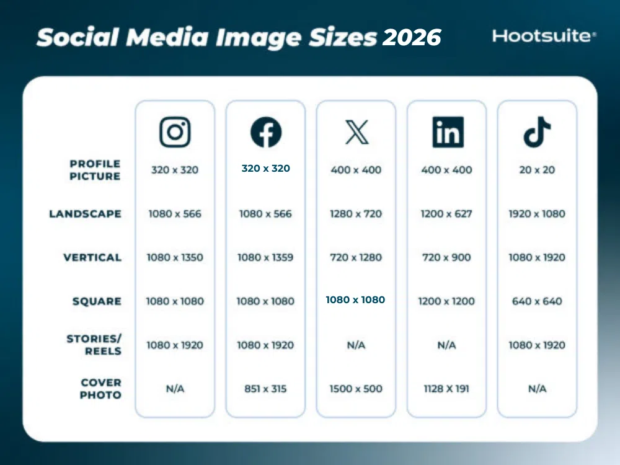
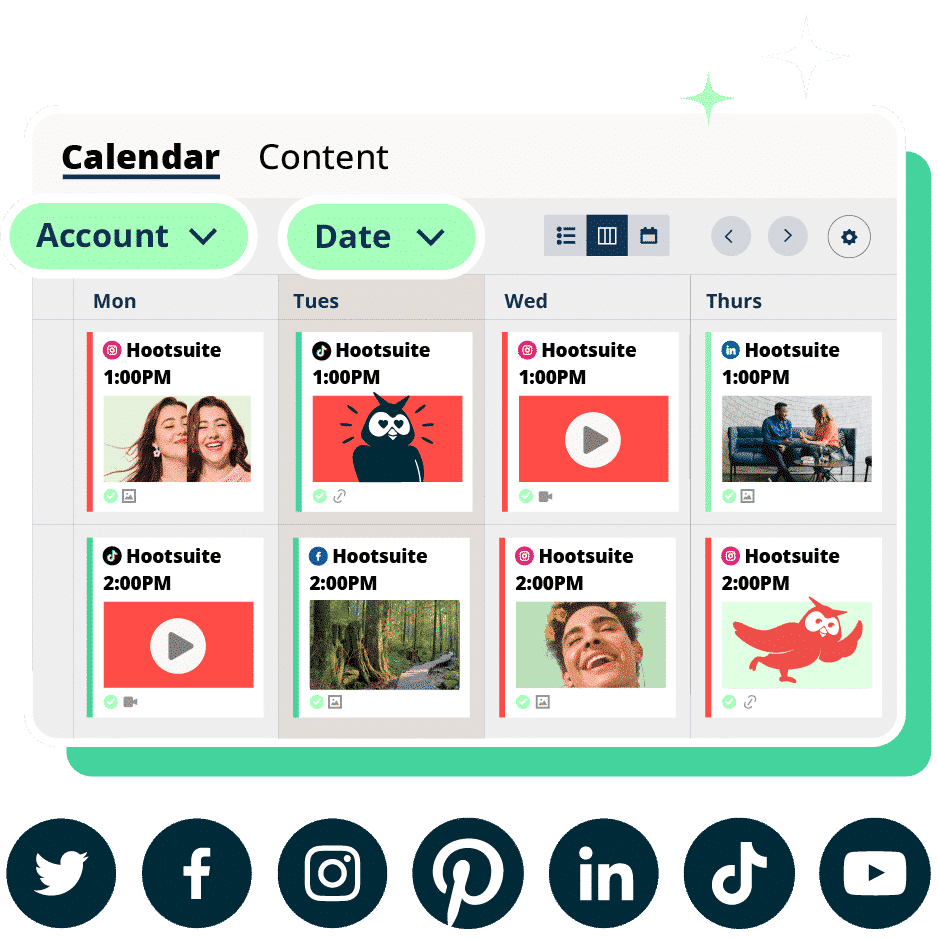
Psst: Using a social media management tool like Hootsuite can make it much easier to crosspost without making mistakes.
15. Add alt text and captions to visual content
Adding alt text and other accessibility features is an important social media optimization technique.
This is because not everyone experiences social media content the same way, which is why accessibility should be part of your optimization strategy.
Accessible visual content on social media includes:
- Alt text descriptions. Alt text allows visually impaired users to understand images by providing a written description of what’s shown. Platforms like Facebook, X (Twitter), LinkedIn, and Instagram now include fields where you can add alt text to images.
- Subtitles. All social videos should include captions. Not only are they crucial for hearing-impaired viewers, but they also help in sound-off environments. Language learners also benefit from subtitles. Plus, people who watch videos with captions are more likely to remember what they saw.
- Descriptive transcripts. Unlike captions, these transcripts describe the important sights and sounds that aren’t spoken or obvious.

How do you measure social media optimization results?
Optimization only counts if you can see the difference it makes. Start by comparing your current numbers against the baseline you captured in your audit, then review them on a set schedule.
Take the time to look at your current social media performance and think about the following areas:
- Are you hitting your goals and objectives?
- Do your social media goals still align with your larger digital marketing strategy?
- Are you posting the right types of content? For example, images, videos, text-only, or a mixture of all three? (Hint: you want to aim for all three!)
- Are your posts resonating with your target audience?
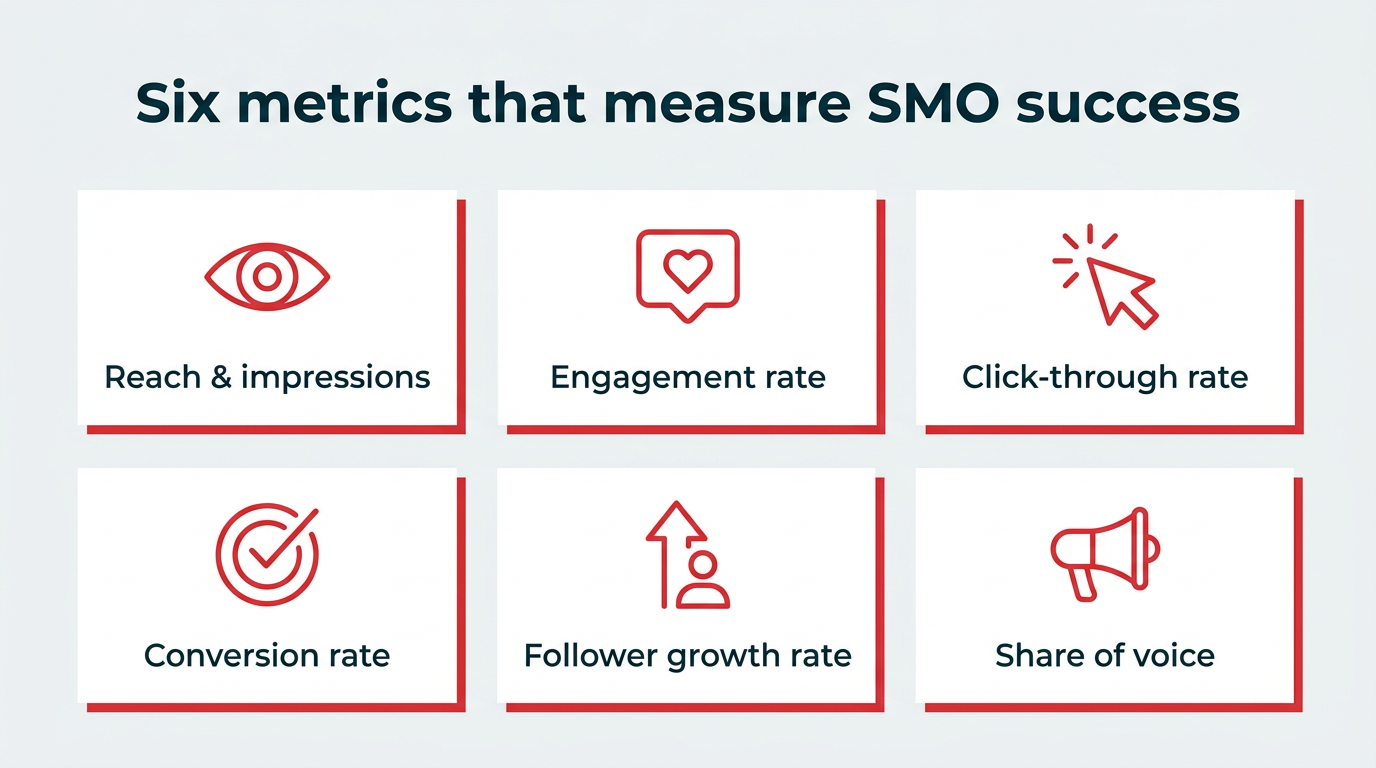
These are the metrics worth tracking as you answer those questions:
- Reach and impressions: How many people saw your content, and how often.
- Engagement rate: Interactions as a percentage of reach or followers, which is the clearest signal that content is landing.
- Click-through rate: The percentage of viewers who acted on your link.
- Conversion rate: How many of those clicks turned into signups, leads, or sales.
- Follower growth rate: Net new followers as a percentage of your existing audience, not just raw count.
- Share of voice: How much of your category’s social conversation belongs to your brand versus competitors.
A simple cadence keeps this manageable. Review performance weekly to catch outliers, run a deeper analysis monthly, and re-audit quarterly. Change one variable at a time, whether that’s posting time, format, or caption style, so you can tell which tweak moved the number.
Why use a social media analytics dashboard?
A social media analytics dashboard like Hootsuite can help you monitor and improve performance across all of your social media channels.
When you’re evaluating an analytics dashboard, look for three things: cross-network comparison in a single view, custom reporting you can send to stakeholders without rebuilding it every month, and competitive benchmarking so your results have context.
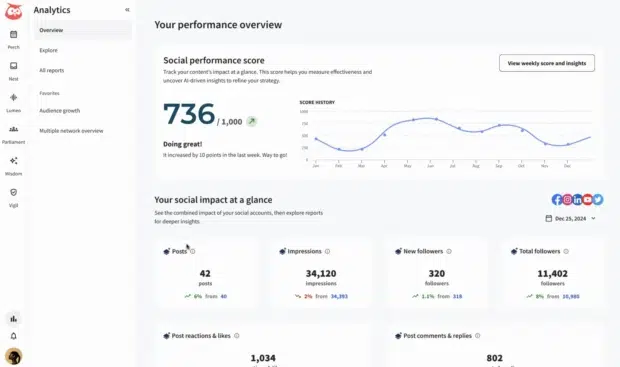
You can use the benchmarking tool in Hootsuite Analytics to compare the performance of your social accounts against the average of brands in your industry with just a couple of clicks.
What are the best optimization tips for each social platform?
The five optimization types apply everywhere, but each network rewards slightly different behavior. Here’s what to prioritize on the major platforms.
- Instagram: Write keyword-rich captions and alt text so posts surface in in-app search. Lead carousels with a strong cover slide, and use Reels to reach people who don’t follow you yet.
- TikTok: Treat it as a search engine. Put your main keyword in the on-screen text, the caption, and the spoken audio. Hook viewers in the first two seconds, since watch time drives distribution.
- LinkedIn: Post from personal profiles alongside the company page, and keep the first two lines of every post strong enough to earn the “see more” click. Native documents and text posts tend to outperform outbound links.
- Facebook: Prioritize native video and content that sparks conversation in Groups. Complete every field on your Page, since it doubles as a local search result.
- X (Twitter): Post more often than on other networks and reply in-thread to keep conversations visible. Keep hashtags to one or two.
- Threads: Lean into replies and conversational posts rather than polished campaign creative. Consistency matters more than volume while the network is still growing.
The common thread: match the format and the language to how people actually use each app, then let your own analytics tell you where to push harder.
FAQ: Social media optimization
What is social media optimization and how does it improve marketing results?
What are the most effective social media optimization strategies for businesses?
How do brands optimize social media profiles, posts, and content for discovery?
What tools help enterprises manage social media optimization at scale?
How do companies measure the impact of social media optimization?
What is the 5/5/5 rule for social media?
What is the 5/3/1 rule for social media?
What is the 70/20/10 rule for social media?
How does social media optimization differ from SEO?
How often should you audit your social media optimization strategy?
Save time managing your social media marketing strategy with Hootsuite. Publish and schedule posts, find relevant conversions, measure results, and more â all from one dashboard. Try it free today.
The post Social media optimization: 15 proven tactics for 2026 appeared first on Social Media Marketing & Management Dashboard.
br https://ift.tt/q7nTYi5
https://ift.tt/nrzN1sI
Comments
Post a Comment